to do list

Posted by admin - June 29th, 2009

To do: put a mount node on each of the four tarot objects so that they can be wielded as weapons

Set up a different projectile effect for each object when it is swung/fired as a magical melee weapon

Perhaps also a different particle effect that is activated for each item

A room with four walls, each with one of the tarot suits and a Latin word (scire, audere, velle, tacere)

Maybe also murals representing a man/woman doing each

Bridges and hallways lead out from this room to four trials/levels of knowledge, courage, will, and silence

A Gothic platformer, but trying to strive for Psychonauts or Ico more than American McGee’s Alice

Tags: , ,

uv unwrapping complications

Posted by admin - June 28th, 2009

Well, I finished the polygon modeling portions of the ogre model and embarked on the uv mapping portions.  Unfortunately, I’ve discovered that Softimage Mod Tool 7.5 has some quirks that make this process a little more difficult.  First, the export as .obj file option has been removed from Mod Tool 7.5, which means that I can no longer export scenes into a form that could be opened by Roadkill, a uv unwrapping application.  Mod Tool 6.0, which still had the export as .obj option, can’t open scenes from Mod Tool 7.5.  The pelt unwrapping method, which is a smoother and cleaner way of uv unwrapping organic, curvy shapes, is not present in Mod Tool and maybe not in Softimage at all.  This is unfortunate, since Ward’s book relies heavily on pelt mapping.  I probably just need to learn to do basic cylindrical and cubic sub-projections using Mod Tool’s texture editor.

Tags: , ,

Ogre model complete

Posted by admin - June 28th, 2009

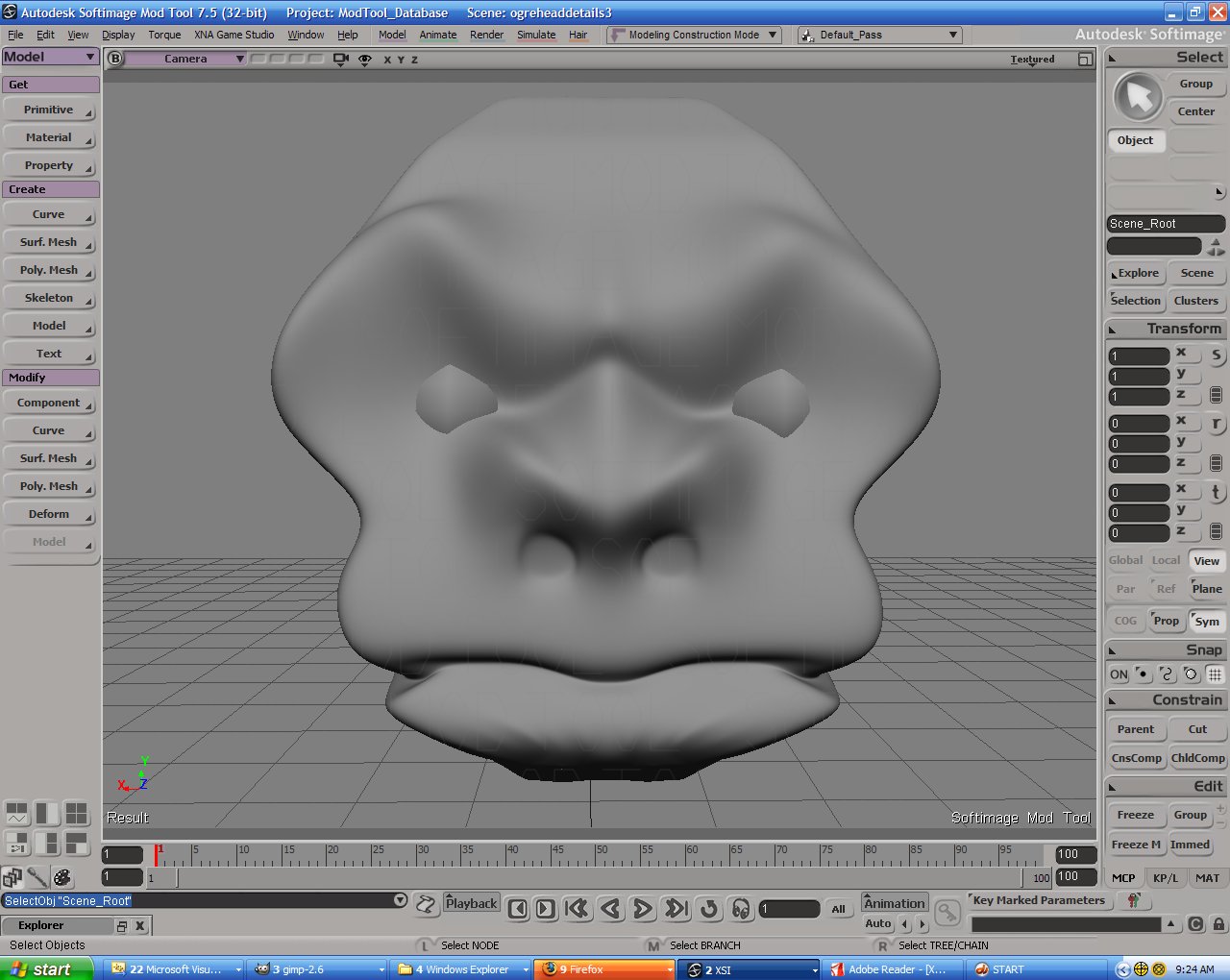
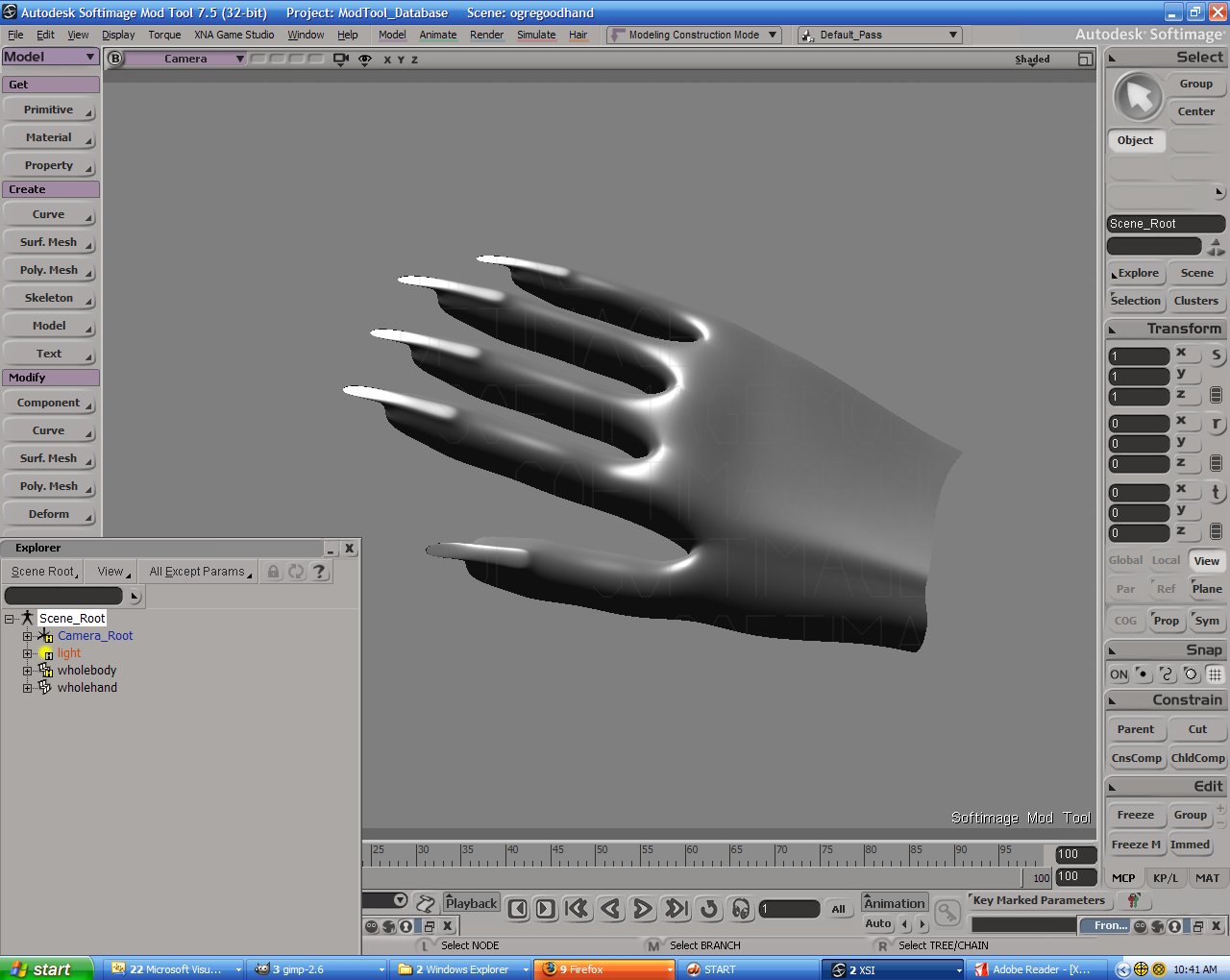
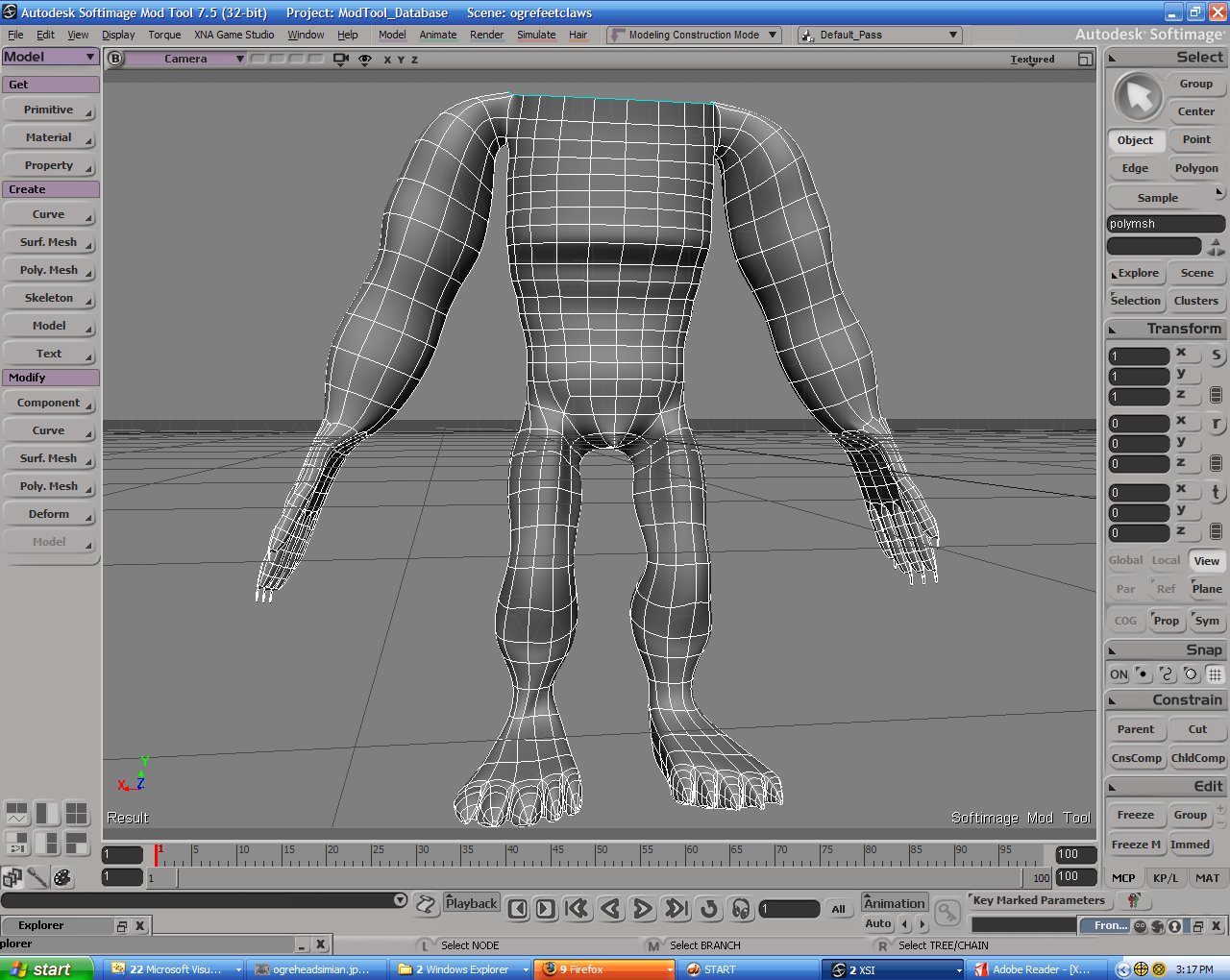
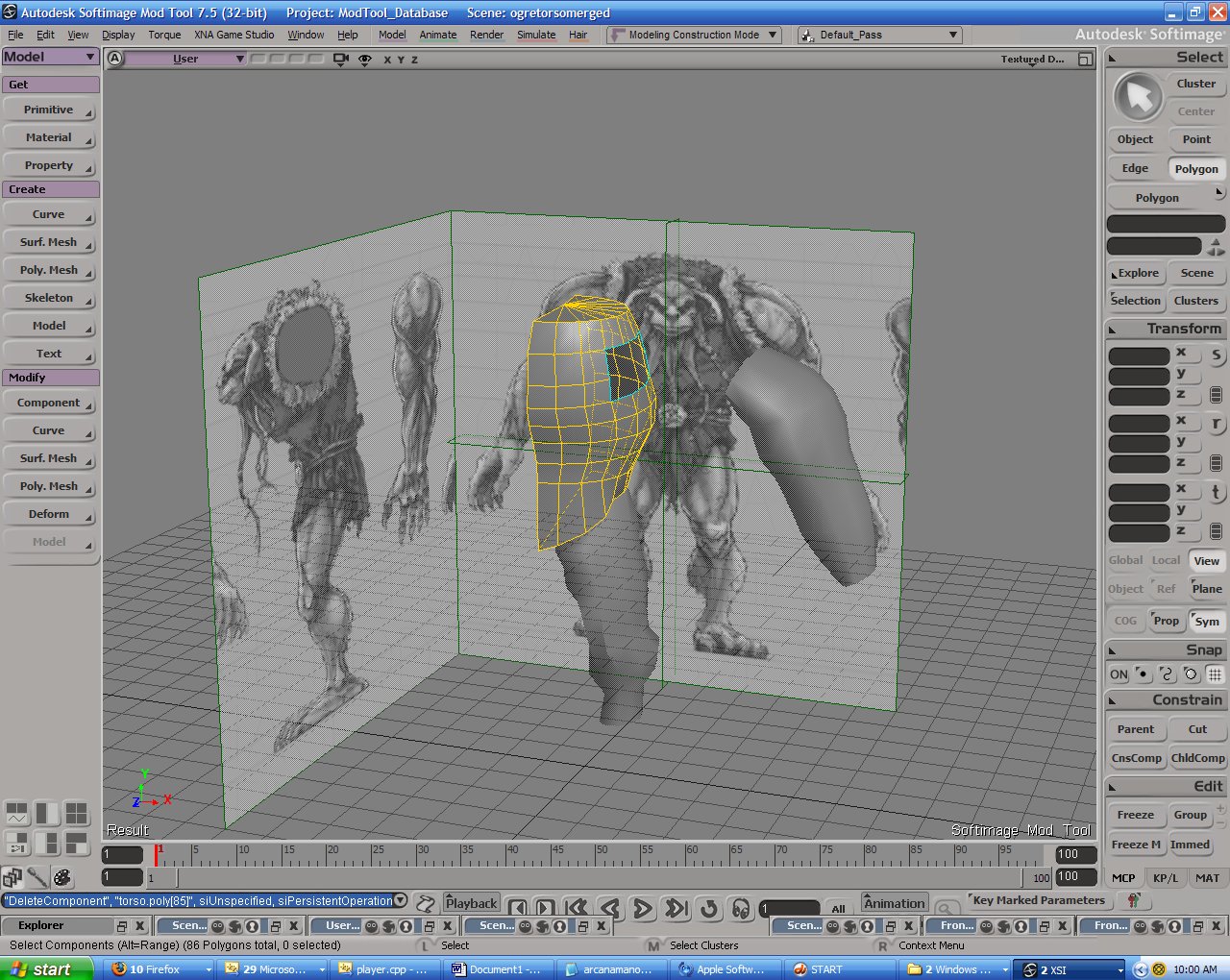
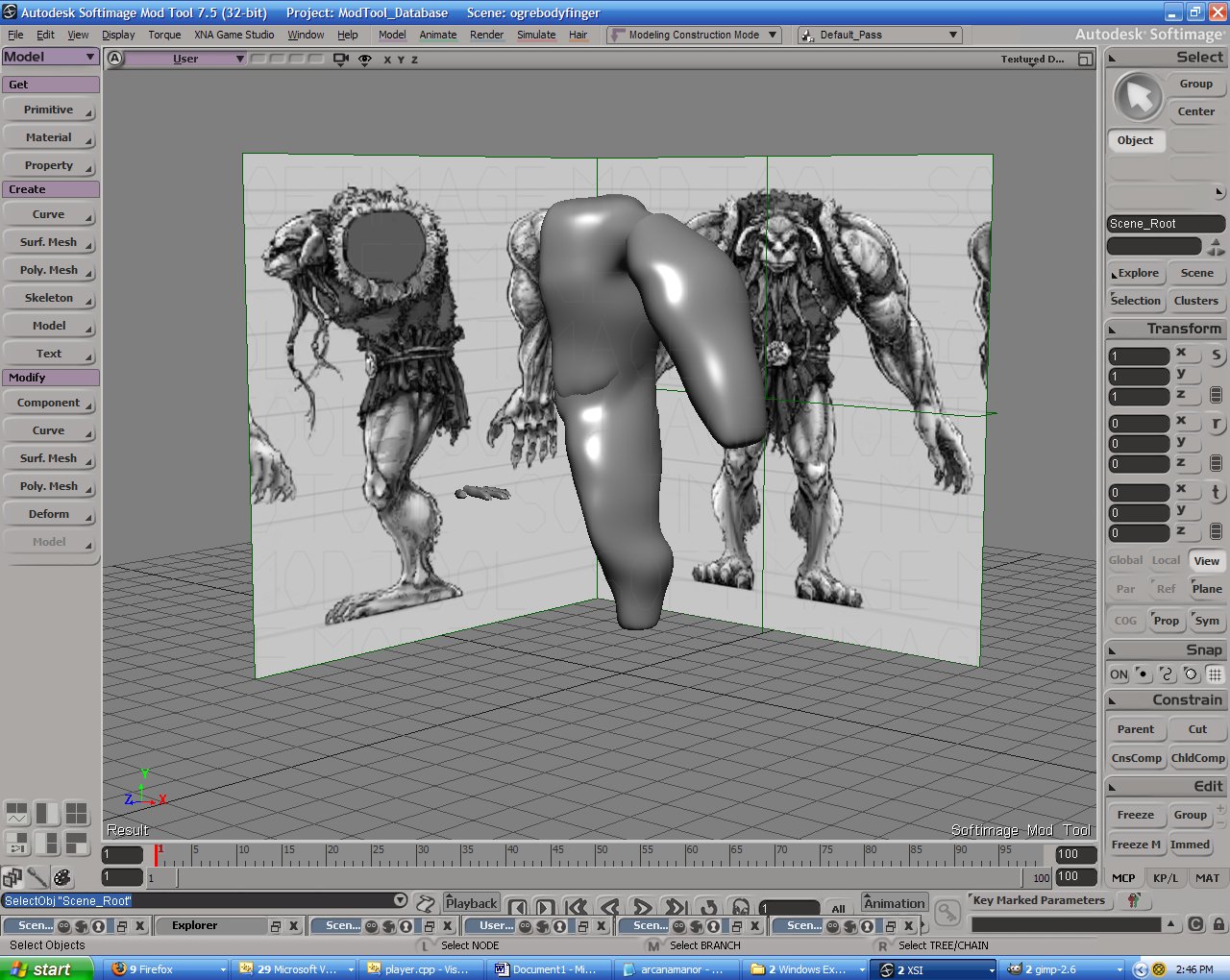
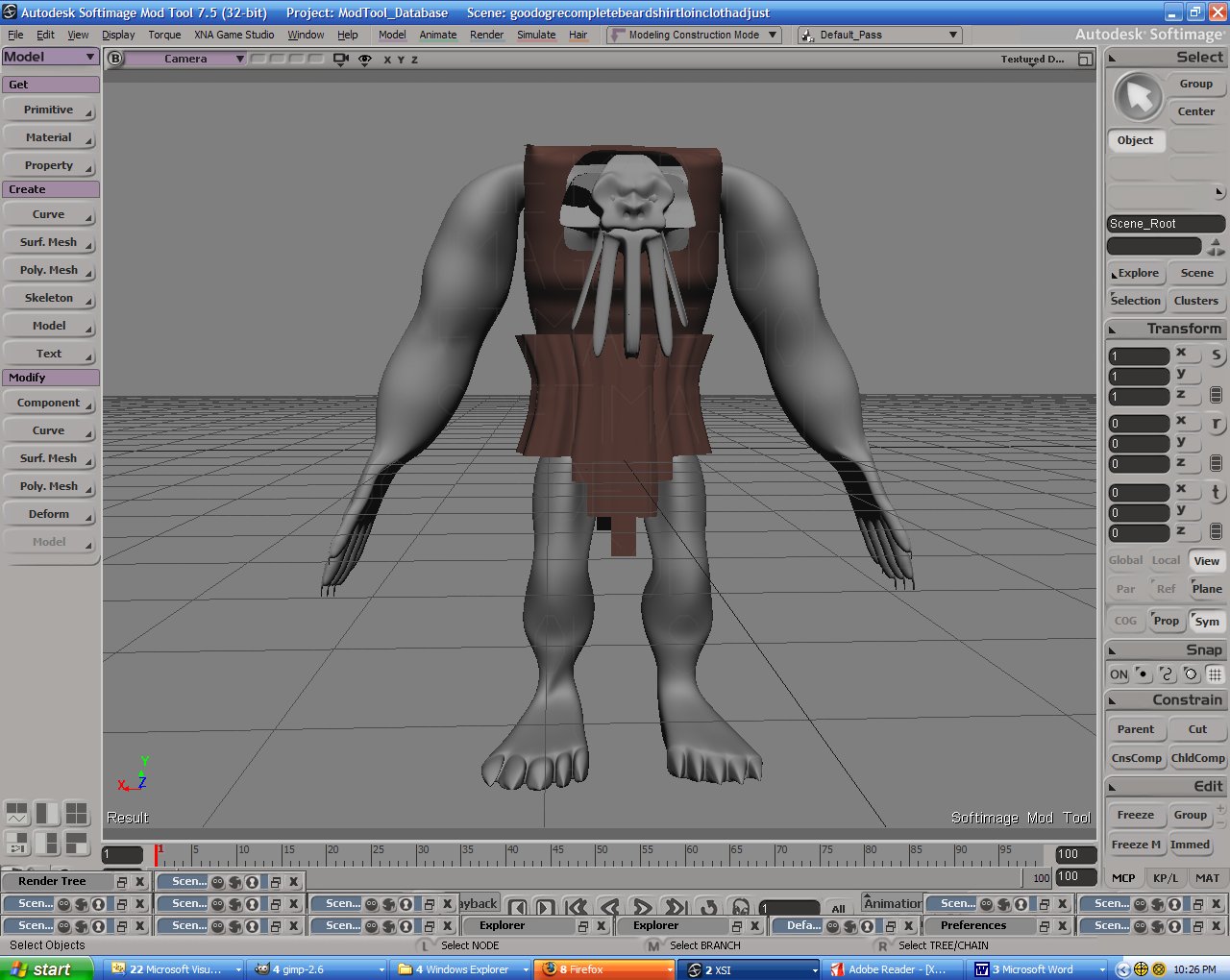
Here is the complete ogre model, which I finished last night, with all of the polygon modeling steps done.  Next comes UV mapping, followed by sculpting, normal map generation, and texturing.

Tags: , , ,

modeling an ogre

Posted by admin - June 28th, 2009


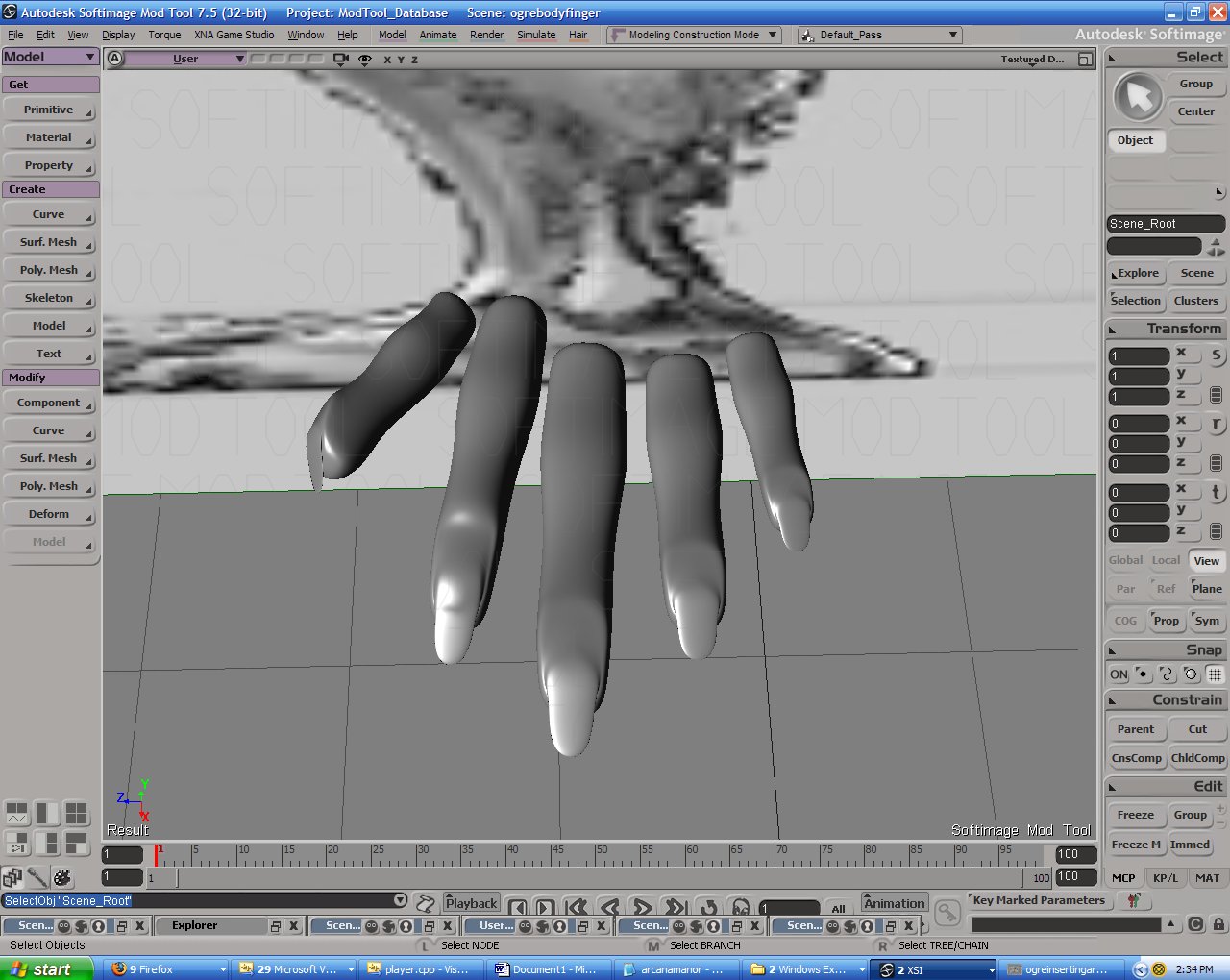
For the last two days, I’ve been working on the ogre tutorial from Antony Ward’s Game Character Development. I went through two iterations of the main modeling portions of the tutorial, which entail building a torso, arms, legs, feet, and a head. The second iteration looks better than the first.

good ogre

good ogre

Tags: , ,

Object selection problems and selecting objects in FPS mode

Posted by admin - June 22nd, 2009

Here is today’s update on Arcana Manor, in the form of a post I made to the ArcaneFX section of the Garagegames forum.  The only addendum I have is that after this post I managed to fix most of the object selection problems, thanks to the help of the user named Gibby.  They were in the playgui.gui file.  Next up is the more challenging problem of selecting objects in first-person shooter mode.

In the process of making many script and code changes to implement several different features, I seem to have interfered with the game’s ability to select objects with the mouse rollover raycast.  I can select the orc AI player, but only from certain angles (specifically from a slight angle while he is running toward the player, and sometimes from behind if the player is standing close to him).  I can’t select the orc corpse at all, even though “corpsehiddenfromraycast” is set to “0″ and “$TypeMasks::CorpseObjectType”  is enabled in “AFX::targetSelectionMask.”  If I run the AFXDemo from a fresh install of AFX 1.7.1, it is much easier to select the orc and the orc corpse from almost any angle and distance, which suggests to me that I’ve done something to mess up the rolloverraycast function or another piece of code or script related to object selection.

I’ve used WinDiff to check afxtsctrl.cp against the same file in the fresh install of AFXDemo, but restoring this file to its original state doesn’t solve the problem.  Could anybody suggest where else I might look for changes to try to fix this problem?  I also checked in GameConnection.cpp because I think some of the object selection code is in that file, but I’m wondering where else the problem might be coming from.

To provide a little context, I am working on a game in which the player can cast spells from first-person mode, like in Oblivion.  So, one of the ultimate goals here is to be able to select objects in first-person shooter mode by toggling the cursor or using the crosshairs.   Gibby’s AFXFps mod and tutorial has been extremely helpful with this, though his solution is to cast spells from a 3rd person “psionics” mode.  For some reason, I can select objects in Gibby’s 3rd-person mode but not in his first-person mode, even when I toggle the cursor on.  I’ve studied the commands.cs script that Gibby uses to switch modes (which involve showing the reticle and the shapenamehud in first-person mode), but I’m not sure which part of this script would be causing the conflict between first-person mode and object selection.

So, a second question once I fix the raycast problem would be: how can I select objects while staying in first-person mode?

Tags: , , , ,

Moving Platforms

Posted by admin - June 21st, 2009

It’s been a few days since I’ve updated progress on Arcana Manor because I’ve been intently involved in implementing an important feature: moving platforms.  These are moving planes or scaled cubes that players can stand on top of, moving along with the platforms as on an elevator.  These moving platforms are important, by definition, to a game in which platforming a key part of gameplay.

Torque Game Engine Advanced doesn’t have out-of-the box support for moving platforms, which means that they have to be added as C++ code, preferably by the addition of one of the downloadable resources on Garagegames.com.  To integrate such a resource with a codebase that I’ve already heavily modified, I had to use WinDiff, a program for comparing files and isolating their differences.  Once I isolated these conflicting code fragments, I had to choose how to merge them by incorporating relevant new lines of code from the resource and discarding irrelevant lines of code.  This process was complicated by the porting of the resource from TGE 1.5.2 to TGEA 1.7.1, especially since the resource itself was actually for TGEA 1.8.1 but had been compiled from multiple TGE versions.  In practical terms, these multiple versions and resources meant that I had to spend several days reading through C++ source code, puzzling out its logic and structure until I could figure out which lines of code were needed and which were not.  I re-compiled the engine dozens of time, de-bugging code changes to preserve the resource’s functionality while updating it and slotting it in with ArcaneFX, melee, and other code changes I’ve already implemented.

I now have moving platforms.  The key is making the player object a child of the platform, which is a pathshape moving along the nodes of a path.

Unfortunately, I have to use a rectangular dts shape that came packaged with an early version of the resource, because the player falls through any dts that I make myself in Softimage.  I think this has to do with the way that collision meshes are set up in the process of exporting the model from Softimage to dts format, but after spending a day on collision meshes I haven’t been able to isolate the problem.

I’m now trying to trigger the moving platforms with a spell so that I can incorporate telekinesis into my magic system.  Since the magic system is the focus of the game and the surreal mansion is the secondary focus, it would be best if these two aspects of gameplay could be tied together.  I have a telekinesis spell that can move an interior instance with the settransform() function, but the interior leaps all at once rather than animating smoothly and carrying the player with it.  If I can trigger a pathshape with a spell, the player could raise and lower bridges with the alterative school of magic, corresponding to the wands.

Tags: , , , , , , ,

Quests on WorldCat and a kind review

Posted by admin - June 17th, 2009

I was happy to discover that WorldCat, a database of online library card catalogs, lists 64 libraries that currently list Quests as part of their collections. The list primarily includes university libraries, with a few community and public libraries for good measure.

I’m excited to see that the book is available to an audience of students in many emerging game design programs.

I was even more excited to find this review, from a user named Veronika on weread.com. She writes,
“A must-have for every game designer or anyone who wants to understand questing in a more sophisticated way. This book has it all - mythology, Joseph Campbell, Carl Gustav Jung, some tutorials and a lot of wisdom :) Another shining piece in my bookshelf.”

That is a really kind review. Reaching an individual reader like that might be the best part of writing a book.

First-person spells and current-gen character development

Posted by admin - June 14th, 2009

Over the last few days, I’ve been implementing some first-person spells in Arcana Manor, i.e. spells that look good from a first-person perspective, which is not really the format for which ArcaneFX is designed.  Gareth Fouche (a Garagegames community member and Torque designer) made a good spell-casting resource that uses projectiles to cast spells–an approach that resembles Oblivion (or Undying) instead of a third-person MMO.  Fouche’s approach is the one I want, but it will take some tweaking to get this going with ArcaneFX.

I also have been working through an excellent book by Anthony S. Ward called Game Character Development.  The book gives a very detailed overview of the processes involved in current-gen character development (i.e. Xbox 360 and PS3), which entails several more steps than the previous-gen workfolow.

In previous-gen character development, the game artist would use a modeling application like 3dsmax or Maya to build the character out of polygons, then UV map the character and texture it in Photoshop.

The main difference between the previous-gen and current-gen approach is the current-gen use of sculpting programs like Mudbox or Z-Brush to paint details onto a model which would have been too time-consuming and memory-intensive to be accomodated on previous-gen hardware.  The artist then converts these details into a normal map, which is an RGB image whose pixel colors indicate the directions in which the model’s normals should be transformed.  (Previous-gen character art tended to include bump maps, which were grayscale images that could indicate only elevation, rather than normal maps.  Current-gen development includes both bump maps and normal maps, as well as other shader-based modifiers such as parallax maps and ambient occlusion maps.)

All of which suggests one thing: I need to recruit a modeler so that I can focus on scripting and programing the game’s magic system rather than building its models. :)

Actually, it’s more a matter of emphasis.  It’s still good to work on 3d models (which could represent characters summoned by the player or custom aspects of the player, such as hands for first-person casting), but the production of art assets is so time-consuming that it would be best to recruit someone whose main talent and experience is in models.

That said, I’ve been working on an ogre tutorial in Ward’s book, and here are a few screenshots.

Tags: , , , , ,

soundtrack clip and working melee

Posted by admin - June 8th, 2009

Today, I implemented two new Arcana Manor features that I’ve been wanting and working toward for a while.

I now have a rudimentary soundtrack in the form of a looping 30-second clip from Danse Macabre by Camille Saint-Saens.  I also managed to fix a melee system that has been broken for a while because of the conflict between ArcaneFX, a melee resource, and shifts between first-person and third-person camera.  This means that the player can now alternate between sigil-drawing, various spell-casting interfaces, and running/jumping.  The player can do some of these things simultaneously, so there is a certain synergy evolving between the various mechanics (though integrating and balancing them is going to be a challenge, which is why the main focus needs to be the magic system).

I also have basic Xbox 360 controller support, which is smoother and faster than the keyboard for movement and combat.  Juggling the various magical interfaces on a controller will be another challenge, but (as I mentioned earlier), this will force me to organize and refine the control scheme in positive ways.

next Arcana Manor goals

Posted by admin - June 6th, 2009

Next Arcana Manor goals for features:

Set up a control scheme using the 360 controller

This will keep the magic system from becoming too unruly (a collection of chaotic key-presses) and more focused around a set of core mechanics

Fix melee system so that the sword can swing more than one time

Implement “platforms that move” for TGEA 1.7.1 using Windiff

Correlate spell-casting with platform movements via settransform function or applyimpulse

Finish modeling demon

Begin to script more spells

Script power-up mechanic for tarot items

Work on first-person spell-casting (such as casting animations for hands, effects that don’t require selectrons to target but work as projectiles as in Oblivion, effects that don’t depend on a zodiac

or make the zodiac vertical

or displace it in front of the player

Put more enemies into the game, make them customizable

Put music in background (e.g. Danse Macabre)

Tags: , , ,

new Arcana Manor feature: mounted particle emitter

Posted by admin - June 6th, 2009

Finally, after six months, succeeded in attaching a particle emitter to the cursor.

This is the beginning of a gestural magic system, since the player can now trace sigils in the air because the cursor leaves behind a trail of glowing particles (in this case, fire) which look like a will o’ the wisp.

Here’s a video of the feature out of context

And here’s a longer video of the complete build, with the particle emitter feature in context

Interested readers might want to watch these videos in conjunction with this previous video of a recent build, which lacks the sigil drawing feature but also showcases the game’s spellcasting interfaces as they’re evolving.

Tags: , , , , , ,

A few theoretical thoughts about magic systems, allegory, programming

Posted by admin - June 6th, 2009

I don’t think about theory much these days, focusing more on creative projects. For the last couple of days I’ve been doing some preparation for my classical myth and media class, which sparked a few theoretical thoughts.  Also, I’m continuing to think about magic systems, inspired in part by a podcast ( on which Roger Travis graciously invited me to be a guest) about this subject and its relation to Arcana Manor. Magic systems have become the focus of my creative design work and my research, and I tend to think about them through the lens of interactive or procedural allegory, a system of expressive rules.

This will make more sense to readers (hopefully) when the podcast is posted.

A magic system is a set of core mechanics (spell-casting is one of them, maybe the primary one) for  simulating supernatural powers and abilities rigorously and symbolically.

Quests, because of their relationship to narrative, tend to be scripted within an engine through quest flags and state changes.

Magic systems can be partially scripted within an engine (depending on the engine’s flexibility), but truly innovative mechanics have to be programmed.  New mechanics tend to require, at the very least, modifications to an engine’s source code and may require the development of new engines (or at least sub-systems within an engine).

What matters to me is allegory as system, as organized matrix of rules for generating symbolic meanings. This is distinct from a linear procession of symbols (i.e. narrative) or from free-floating pool of symbols merging into each other (collective unconscious, dream). In linear mediums, allegory manifests itself as narrative (although I wonder if poetry, in its capturing of de-contextualized images, may be allegorical without being solely or even primarily narrative). Rimbaud’s Vowels or Baudelaire’s Correspondences are dense symbols without narratives. Dante’s Divine Comedy does chronicle the adventures of one pilgrim (Dante) through Hell, Purgatory, and Heaven, but the descriptive focus of the poem is the spatial organization of these realms and their inhabitants. The afterlife is a cosmological system for representing the punishment of sin and the rewarding of virtue.

A mythology (whether real as with the Ancient Greeks or invented as in the Cthulhu Mythos) is a system (a pantheon, a set of places, artifacts, recurrent events, themes). Many narratives can occur within a mythos, but many systems can also be generated by a mythology. When I was thinking about quests, I was trying to connect narrative and system, to explore their generative interplay. As I think about magic systems, I am more and more concerned with dynamic, procedural systems, which can be expressive in interactive, procedural, re-configurable ways.

Ritual is a key middle term.  Ritual is enacted myth, enacted symbolism.

Eric Zimmerman says that there is magic in games but argues that this magic is the thrill of creativity and problem-solving, which are distinct in his mind from a mage’s 8th-level fireball spell or the mystical experiences of organized religion.

I don’t see these three aspects of magic as inevitably distinct.  There are all sorts of connections to be woven between them.

That’s why I have a Clive Barker quotation above my desk, which in condensed form says “magic is the first and last of the world’s religions: a religion whose profoundest ritual is play.”  The quotation is longer but would require a detailed gloss to do it justice, because the idea is too important for me to treat lightly.  But the main point is that in Barker’s mind the three aspects of magic in games are intertwined expressions of one another.  (And he puts his money where his mouth is, since this quotation is from the introduction to his Imajica collectible card game, and he has also discussed the metaphysical implications of the magic system in Undying.  Incidentally, the magic system in Undying may be my second favorite magic system, just beneath Eternal Darkness.)

(A sidenote on Jung: Jung coopts the concept of the symbol for psychoanalytic purposes, but the term comes to prominence in Western thought in Romanticism (English, German, French), which precedes Jung chronologically. (e.g. Coleridge, Baudelaire, Rimbaud, Nerval).  In the game Eternal Darkness, the narrator invokes Jung, Freud, and Skinner as possible correspondences to the three Ancients, but then dismisses these psychoanalysts as inadequate to the horror and majesty of the beings represented by the runes. This is a nice way of suggesting that, while Jung is a key figure in understanding symbols, their content and operation eludes his unitarian and trans-historical attempts to explain all symbols as products of a psychoanalytic entity (the collective unconscious) which he invented. A theoretical entity which originates in his own German Romanticist/early modernist context and his Freudian training.)

And allegory precedes Jung also (Plato, Spenser, Dante).

I need to read Angus Fletcher’s Allegory: Theory of a Symbolic Mode.

Question for further research: what are some of the most innovative magic systems, both in terms of mode of spell-casting, effects, and symbolism?

Mage: The Ascension and Mage: The Awakening (tabletop)

Magic: The Gathering (cardgame)

Betrayal at Krondor (crpg)

Arx Fatalis (crpg)

Loom (Adventure Game)

Eternal Darkness: Sanity’s Requiem
Tags: , , , , , , , , , , , ,

Upcoming Games (covered at E3) in Order of My Excitement

Posted by admin - June 5th, 2009

Castlevania: Lords of Shadows (Xbox 360)
The Lost Guardian (PS3)
Assassin’s Creed 2 (Xbox 360)
Dragon Age: Origins (Xbox 360)

Tags: , , ,