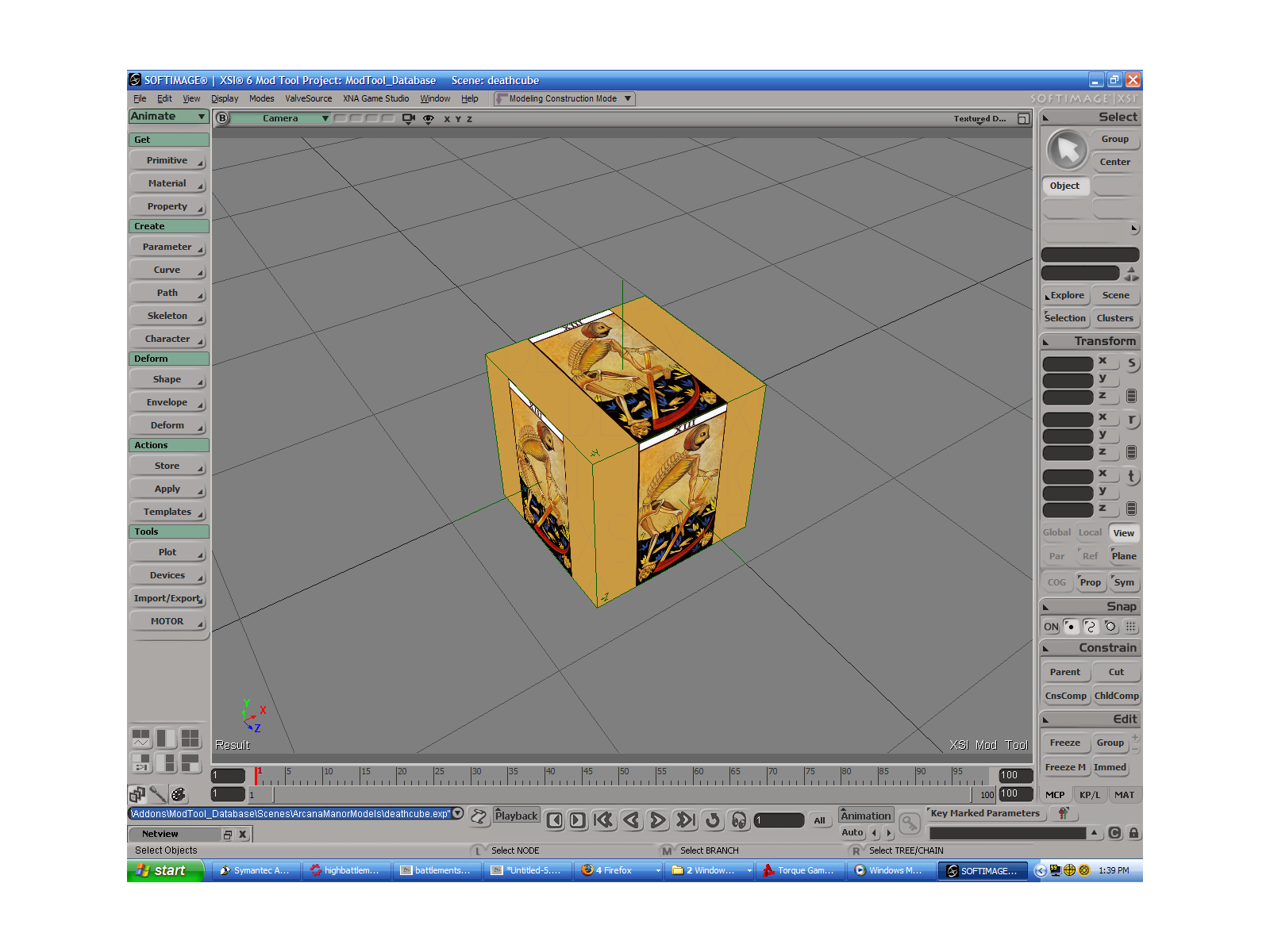
2 New 3d Models

Posted by admin - March 14th, 2009

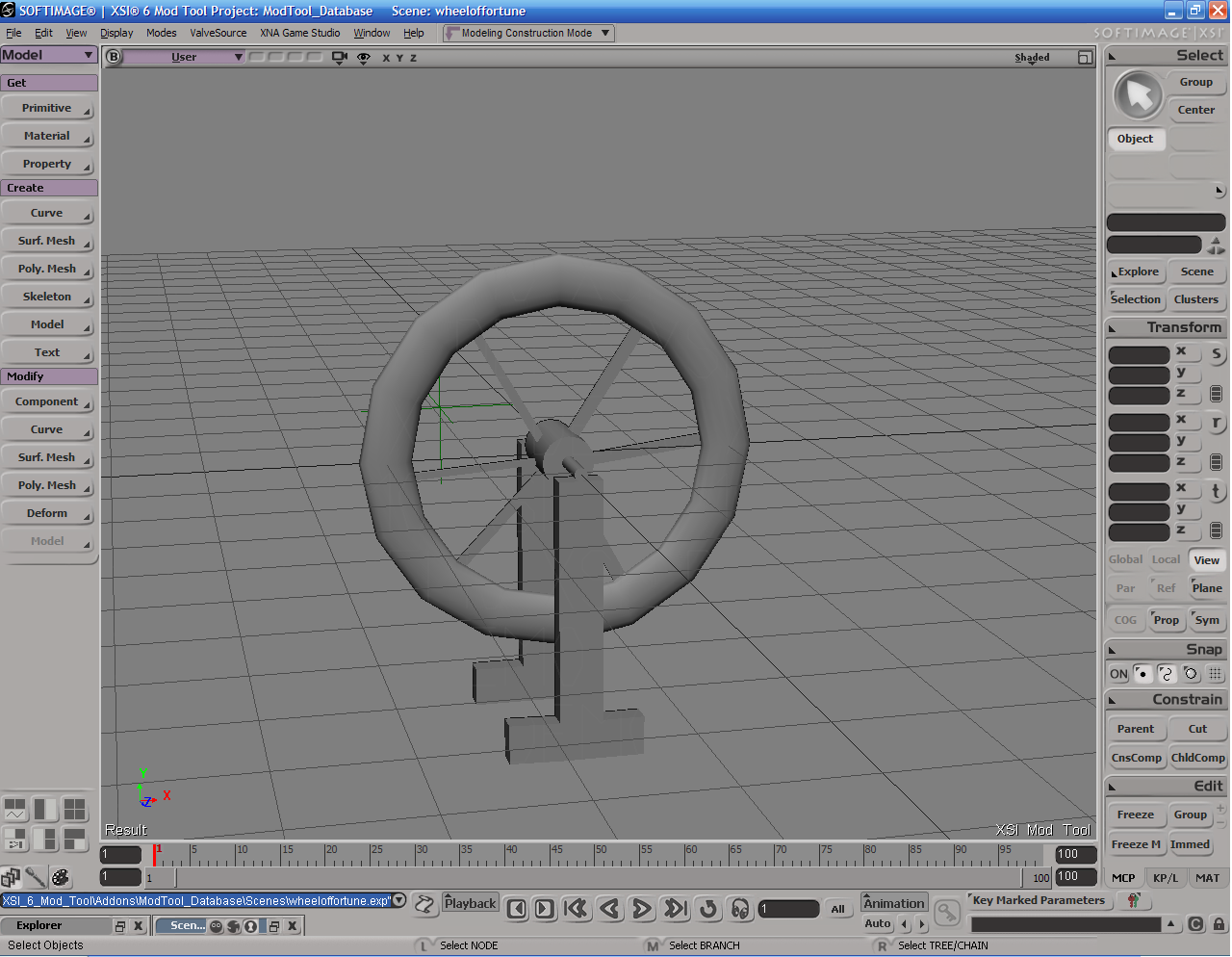
Here are two new 3d models that I made in XSI: one a grimoire, probably the architect’s notebook.

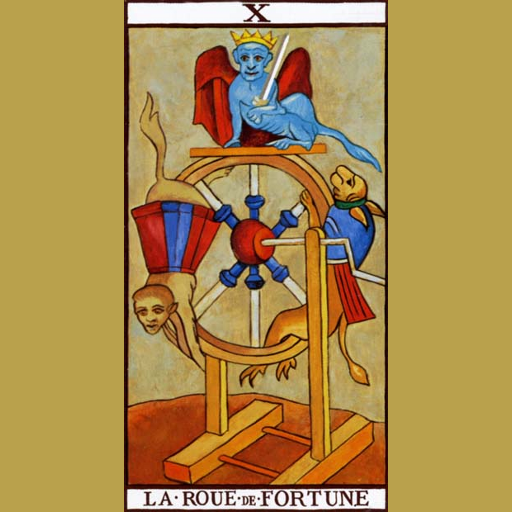
The second is a wheel based on the Wheel of Fortune card from the Marseilles deck. I would like to produce one object for each of the major arcana cards.

Tags: , , ,

Magic System, Part III: Implementing specific features

Posted by admin - March 13th, 2009

Overview

Each tarot card is a spell.

The minor arcana (the suit cards with varying numbers of wands, cups, pentacles, and swords) are low-level alterative, restorative, protective/illusionary, and aggressive spells. Players cast these spells very frequently, and the process of casting them should be quick and addictive.

The major arcana (the 22 pictorial cards with Magician, High Priestess, Tower, etc.) are ultra-powerful spells used to resolve especially tough situations (e.g. apparently undefeatable bosses, seemingly impossible puzzles, totally blocked or inaccessible areas in the manor)

MINOR ARCANA SPELLS

The minor arcana spells are relatively easy to execute.

The minor arcana are less powerful (but still effective) spells, requiring only the collection of items and the tracing of a simple sigil in the air.

To cast a minor arcana spell, the player must have at least one of the objects associated with it (e.g. at least one sword)

The player must trace the correct (simple) sigil in the air with the respective item (e.g. hexagram, pentagram, Saturn astrological symbol, Mercury astrological symbol).

Tracing a hexagram with a sword equipped has a different effect than tracing one with a cup equipped, i.e. the sword hexagram attacks and the cup hexagram heals.

Swords are charged with aggressive magic, representing the power of the analytical mind to destroy demons of illogic and delusion. Collecting a sword object allows the player to fling one flying sword as a projectile at an enemy. Collecting multiple sword objects powers up the spell, allowing the player to fling as many flying swords as he has collected sword objects.

Two options for how the powering up of spells works (I haven’t decided which)

Spells remain powered up (i.e. the player doesn’t lose spell levels when he throws swords). For this reason, power ups should be rare rewards, distributed and hidden sparingly throughout the level.

[OR: Spell levels deplete in power every time the spell is cast, so items must be collected constantly and are distributed plentifully.]

Wands are alterative, representing the power of the will. The player can use the wand to telekinetically raise platforms to form staircases and launching pads. Wands can also form bridges out of pure light and energy so that the player can pass over otherwise impassable chasms.

Pentacles are protective: they can produce a glowing transparent shield that is as powerful as the number of swords or cups that one has currently collected

Cups are restorative: they release a healing flood of soft-colored blue or purple light that raises mana or health.

In traditional occultist thought (Levi, Crowley, Jodorowsky), each of these arcana stands for one virtue of a magician: cups = knowing, swords = daring, wands = willing, and pentacles = keeping silent.

Players enact each of these arcana through a core mechanic, which is a spell power: keeping silent = stealth through invisibility, daring = leaping perilous chasms, knowing = destroying the enemies of delusion and solving puzzles, willing = bending the environment to one’s will by telekinetically moving platforms or causing

MAJOR ARCANA SPELLS

The major arcana are powerful spells that can only be unleashed through tracing the right sequence of sigils and pressing the right buttons, registered through color and sound.

They take time and deliberation to cast: the equivalent of a ritual.

They have less time pressure on them than the minor arcana spells, i.e. they are more like puzzle-solving, albeit complex puzzles with multiple solutions.

They are usually not cast while enemies are attacking, unless it is a very slow enemy or a horde of minor enemies banging at the gates.

The Death card can destroy whole levels of enemies (e.g. the enemies banging at the gates above), the Devil card can summon powerful demonic bosses to defeat or powerful demonic allies to aid you, the strength card can conjure into existence powerful magical protection (like a whole suit of armor)

E.g.:

Saturn Symbol + x + Aries Symbol + pentagram + y = the Devil, which summons a powerful demonic ally

A set of colored boxes at the bottom of the screen that light up as sigils and buttons are successfully or unsuccessfully executed

Maybe a musical tone plays also, à la Loom.

Tags: , , ,

Magic System, Part II: Goals and Features

Posted by admin - March 13th, 2009

The problem: Too many MMO and single-player RPG’s have a repetitive and simplistic magic system in which players press buttons on a tray of icons, watch a series of animations to play throughout casting time, and then wait through the cool-down period before they press the mouse button again. Systems like this are repetitive and dull: automated to the point that players are almost uninvolved.

The goal: Magic, by its very definition, should feel out of the ordinary, a complex mixture of arcane art and science practiced by highly trained adepts who revel in the skill and the rules they have mastered, much as programmers or gamers do. Magic is a metaphor for the power of the human imagination to shape reality and perhaps, taking a cue from Clive Barker, for the creative activity of play itself. Hence, we need to look back at the history of the most innovative RPG’s, action-adventure, and survival horror games to re-enchant and re-activate the process of casting spells in games. It could also be helpful to consider human beliefs and practices surrounding magic in myth and ritual. Articles about magic systems in games often argue that because magic is a “fantasy construct” that no system is inherently better than another, since there is no way to judge the accuracy of a system that simulates a fiction. This attitude can result in the approach of “do whatever will be easiest for players” or, worse, “do whatever everyone else is currently doing,” resulting in the current problem of dull and repetitive systems.

But magic systems in games haven’t always been so homogenous, in human belief or in game practice. As Matt Barton has demonstrated in Dungeons and Desktops (and team member Kris Maxwell has confirmed in conversations)¸ CRPG’s like Dungeon Master and Betrayal at Krondor involved innovative and experimental magic systems. Tabletop RPG’s like Mage: The Ascension and survival horror games like Eternal Darkness have explored the philosophical dimensions of magic in innovative gameplay mechanics (not to mention card games like Magic: The Gathering). Adventure game Loom had a magic system

I would like to implement 5 features in order to make the magic system of this game exciting, fun, sophisticated, and engaging.

    1. A magic system based on a system of symbolic correspondences
    2. Magic that alters the physical environment to help overcome physical obstacles (e.g. raising platforms, building bridges)

(This is part of a more general aim to produce spells with gameplay effects that are more varied and psychedelic than the standard damage/buff/heal effects. For example, spells that cause solid stone to warp and liquefy or spells that grant visionary passage into other dimensions of pure sound and light (or demonic realms of the dead).
3. Spells are powered up by collecting minor arcana of the tarot (wands, cups, swords, & pentacles), which can be combined to produce spell effects.
4. Players cast spells by tracing sigils, such as flaming runes and pentagrams, possibly making use of the Nintendo Wiimote (since TGEA is cross-platform and I’m especially interested in aiming this game at consoles).
5. The magic system might take full advantage of 3d space by having players mold, weave, and sculpt spells, creating varying spells effects by modeling 3d shapes and directing the vectors of these shapes towards different 3d directions.

1. The magic system is based on a system of symbolic correspondences in which symbols stand for other symbols in an array or “grid,” i.e. colors stand for virtues which stand for objects which stand for gods which stand for schools of magic, or colors = notes of a scale = tarot cards = runes and so on.
1a. Players combine symbols pictorially or semantically to produce spell effects. To cast spells, players must master a language of symbols.
The system should be both meaningful and action-packed. The best example I’ve seen so far is the magic system in Eternal Darkness, where casting spells involves the combination of many different runes of three different colors, which stand for the three demonic deities of the world as well as human powers of body, mind and sanity. Spells become more powerful the more the player learns the language and symbol system of the game: which runes stand for enchantment, which stand for objects, which stand for self. In learning this language, the player also has to internalize the game’s mythology: which of the deities has power over which realm, and how these realms trump each other in rock-paper-scissors fashion.

2. Because Arcana Manor is a platformer, many of its challenges are environmental. One original feature of the magic could be its ability to help players overcome these environmental challenges by altering the environment physically. An example of effective use of magic that physically alters the environment is Soul Reaver 2 and the Legacy of Kain series generally, in which elemental magic can create gusts of wind that the player can glide on with his wings, disable the trap of a cyclopean eye with darkness, light up jewels that lower ice bridges, and summon earth platforms.

    1. The magic system will be, in part, based on the minor arcana of the tarot (which refers to the suits of wands, cups, swords, and disks/coins/pentacles). Players collect these items as power-ups that make spells more potent. There are an obvious set of elemental correspondences to these four suits (fire, water, air, earth) and also traditional schools of magic (alterative, restorative, damaging, and protective). It would be cool if these magical functions were more action-packed, cognitively challenging, and dexterity-oriented. Castlevania is addictive because the repetitive activity of whipping enemies is inherently enjoyable and requires timing to execute correctly. Throwing four swords that fly through the air or jumping on a pentacle/disk summoned from below would be comparable examples of quick an engaging magical gameplay.
tarotmagician.jpg

4. The magic system involves tracing flaming runes and pentagrams in the air to create various magical effects. I think that the add-on ArcaneFX could help to build these features, but they might also require substantial engine modification in order allow the player to draw sigils using particle emitters and to correlate these drawn symbols with gameplay effects. Shaun Walsh already has some really excellent ideas for the conceptual design of this code. Shaun writes, “Castlevania for the DS had the same concept, but they had built in functionality for that. How it would work is you would have to have a file that stored 2d coordinates of the first mouse click on the screen (where he starts drawing) and then does a match function to determine the roundabout next point he would have to draw to, something like a direction map. Heres an example
User starts drawing at 25,25
So, the computer would figures the next point is 25 points lower, and 30 points to the right so the next cord would be 50,55. Then it would go onto the next point. The file would look like this
0: +25,+30 (this is actually the second point)
1: +25, -30
2: -25, -30
3: -25, +30
4: END_SPELL

This would make a pyramid drawing. You would obviously have to make a buffing system that would make use of extreme math cause the user wouldn’t be able to click EXACT coordinates. I would think the closer he is to exact, the more critical the spell is. Obviously, some of the marks he would be drawing would be more complicated, but that’s just a basic concept.”

    1. Tracing glyphs and sigils in the way outlined in the previous point takes place in 2d, i.e. the hexagrams are a 2d overlay on a 3d environment.

We could make the system more interesting if we figured out how to take full advantage of 3d graphic capabilities in creating a magic system.
Kris Maxwell’s suggestion:
A system in which players could change the powers of a spell by directing parts of its sign toward specific 3 dimensional-vectors.
Imagine the casting space to be a north-east-south-west cube.
For example, tracing a fire rune with its tip toward the north quadrant might mean “ignite,” but directing the tip toward the south would be “extinguish.” Whereas rune-tracing would be based on two-dimensional coordinates and implemented through a drawing engine, a three-dimensional method would feel more like a very rudimentary 3d modeling application, and its coordinates would be stored in a 3d matrix rather than a 2d array.
The player would be using two virtual hands for weaving, shaping, molding patterns out of pure light and energy, like a sculptor shaping clay or a weaver making a cat’s cradle.

loom.jpg

Maybe shaping a cube would be one spell, shaping a dodecahedron would be another (or twelve others, depending on how it were turned), and shaping a sphere would entail yet another spell.
This would almost be a very simplified 3d modeling engine within the game, combined with a semantic-based system projected onto three-dimensional space.

See cube of space from neo-masonic organization BOTA

cube12trumps.gif

6. Magic is a metaphor (power of human imagination to shape reality)
The four weapons of a magician (knowing, daring, willing, and keeping silent) traditionally correspond to the four tarot suits.
Our magic system will express these ideas through gameplay,.
I’m look for ways to express these abstract human powers, abilities, virtues, activities as spells with concrete effects.

7. Other features that could be incorporated into a magic system:

Summoning circles to protect the caster from the spirits she calls up, and triangles to contain the spirit.
Draw the circle or triangle incorrectly, or step outside of it during the conjuring, and the spirit attacks you.

magiccircle.jpg

Planetary alignments (via the Torque ability to create celestial bodies that move cyclically), including phases of the moon
Certain variations on a spell, such as which planetary point of the hexagram to start tracing first, are more effective during certain alignments (cf. the phases of the three moons and their relationship to black, white, and red magic in the Dragonlance Chronicles)
Combinations of alchemical ingredients (e.g. sulphur, salt, mercury) to produce spells
Burning certain forms of incense (with appropriate smoke/fire animations)

Tags: ,

New team member Shaun Walsh

Posted by admin - March 9th, 2009

Shaun Walsh, an experienced programmer in the process of learning Torque, has graciously agreed to be on the Arcana Manor.  Shaun is interested in conceptual code design, i.e. planning out how to implement various features, such how to program a magic system in which the player will trace runes and sigils on the screen to produce various magical effects.  This is a tremendous addition to the team given the difficulty of programming and how slow I am at learning it. :)

Shaun has experience in Php, C/C++/C#, VisualBasic, and a host of other languages.  As an example of his coding facility, here is what he was able to come up with very quickly regarding the implementation of the mechanic for tracing runes:

So, this wouldn’t be an overnight project by any means. Your drawing of the spells to the screen is interesting. Castlevania for the DS had the same concept, but they had built in functionality for that. How it would work is you would have to have a file that stored 2d coordinates of the first mouse click on the screen (where he starts drawing) and then does a match function to determine the roundabout next point he would have to draw to, something like a direction map. Heres an examples

User starts drawing at 25,25

So, the computer would figures the next point is 25 points lower, and 30 points to the right so the next cord would be 50,55. Then it would go onto the next point. The file would look like this

0: +25,+30 (this is actually the second point)

1: +25, -30

2: -25, -30

3: -25, +30

4: END_SPELL

This would make a pyramid drawing. You would obviously have to make a buffing system that would make use of extreme math cause the user wouldn’t be able to click EXACT coordinates. I would think the closer he is to exact, the more critical the spell is. Obviously, some of the marks he would be drawing would be more complicated, but that’s just a basic concept.”

Something like that would have taken me hours to figure out, which shows why recruiting team members if important.  Welcome aboard, Shaun.

Tags: , , ,

Programming progress

Posted by admin - March 4th, 2009

Over the last several weeks, I have implemented several features in TGEA, but many of them are in separate project files, builds, and/or software versions.  For this reason, I need to keep a list of these so that they can eventually be combined into one file.

1) Implemented a functional inventory system with associated GUI (along with 2-3 separate inventory systems from GarageGames, many of which were stymied by outdated resources but all of which were educational).

2) Implemented two spells which allow the player to throw a fireball, as well as an associated system that enables invisiblity and healing spells if I bind them to a key.

3) Am well on my way to implementing a simple melee system by James Thompson.

Some of my fellow garagegames developers have suggested that I should invest in the ArcaneFX add-on, which has a lot of customizable special effects that lend themselves to a magic system.  That’s a good idea, although parting with the $85 dollars at this point in time is a painful prospect. :)

New Arcana Manor video

Posted by admin - March 3rd, 2009

As promised, here is a new video of a small portion of a level in my game-in-progress, Arcana Manor.

I built this level in the Torque Game Engine Advanced, and I made the 3d models of the tarot suits in XSI. I also made many of my own textures in GIMP. I scripted the inventory system using resources from Garagegames, combining Torquescript with my own icons to make a GUI that would keep track of the tarot suits as they are picked up. This level demonstrates some rough platforming action and the tone of the game, as well as the ability, which I scripted, to pick up cubes representing the 22 major arcana.

wiki for Arcana Manor

Posted by admin - March 1st, 2009

Arcana Manor also now has a wiki here (http://arcanamanor.wikispaces.com/).

The idea of a wiki was suggested to me by my collaborator Ron Smith, as a place for a “centralized control document” so that everybody on the team (and new team members) have access to all design documents, sketches, and inspiring links.

Tags: , ,

Arcana Manor under construction . . .

Posted by admin - March 1st, 2009

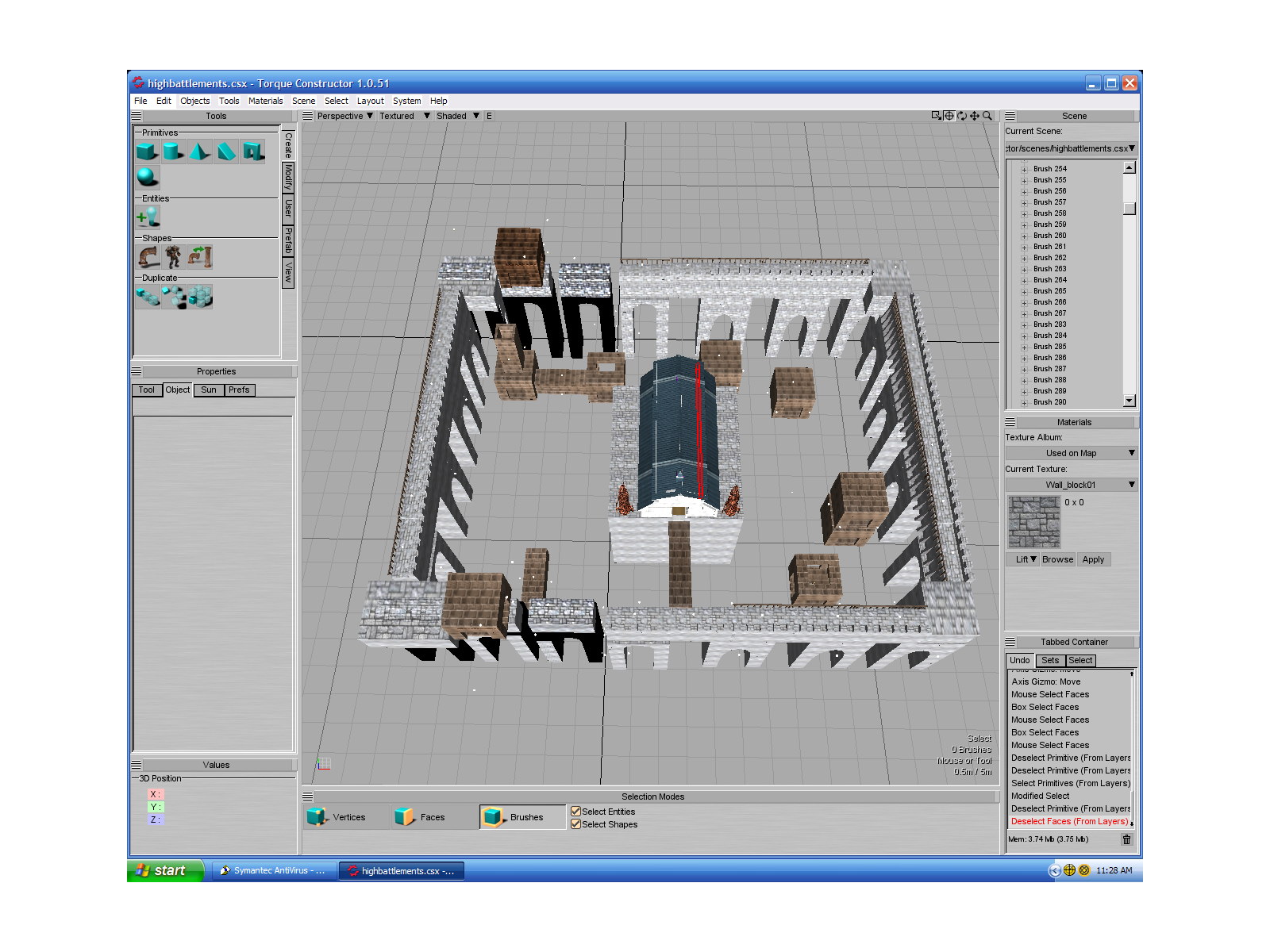
Here are the beginnings of a level in Arcana Manor that I’ve been building in Torque Constructor.

Arcana Manor Screenshot

Arcana Manor Screenshot

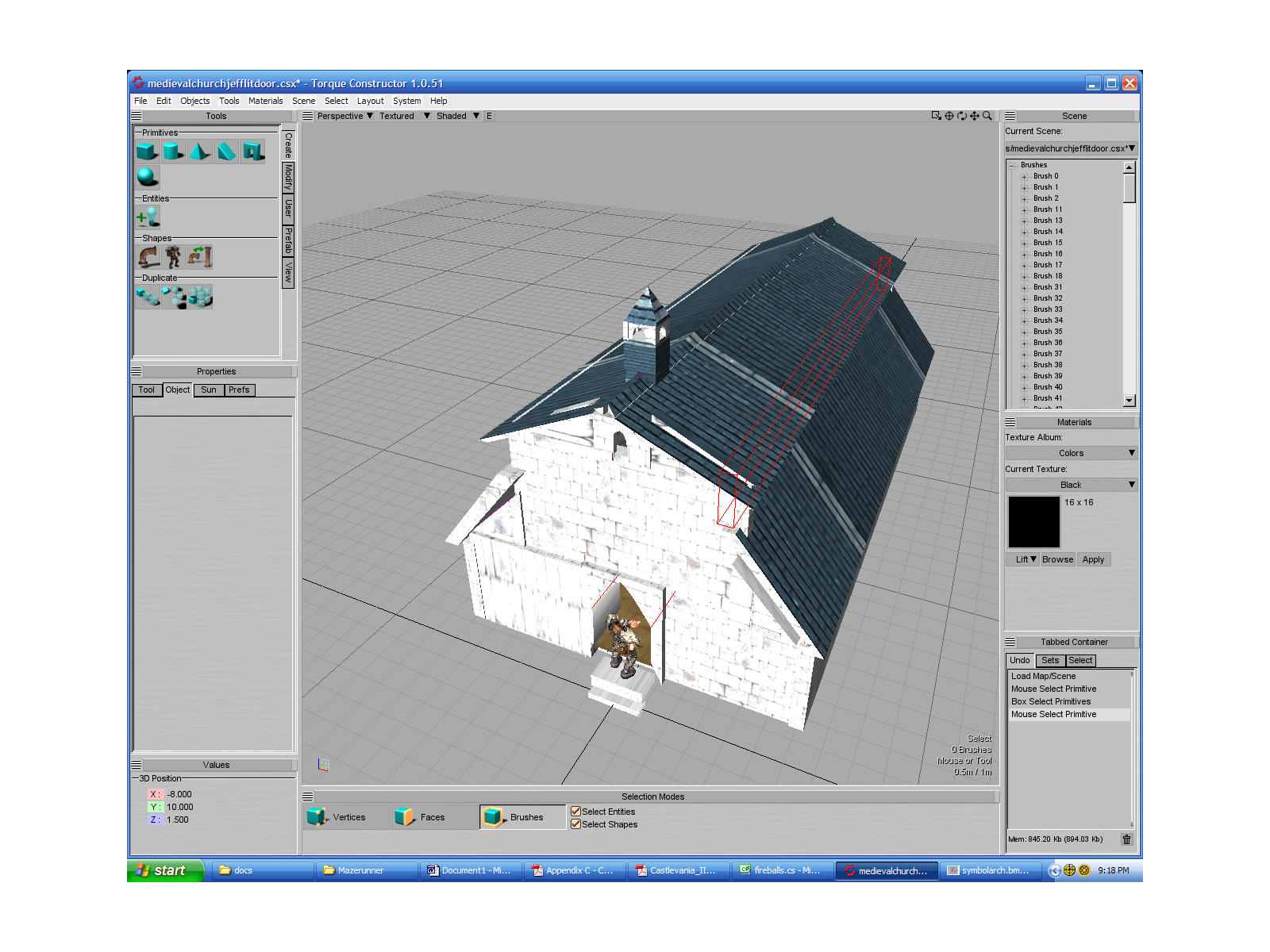
This level contains, at the center, a medieval cathedral that I built in Constructor several weeks ago following a tutorial on garagegames.

cathedral made in Constructor

2) I’ve also made 22 cubes with textures from the major arcana of the Marseilles tarot deck and exported them from xsi into Torque.  This took a lot of effort because the XSI exporter is still a bit clunky and requires a lot of manual scene set-up involving dummy nodes, collision meshes, and naming conventions that have to be set exactly right in order to export.

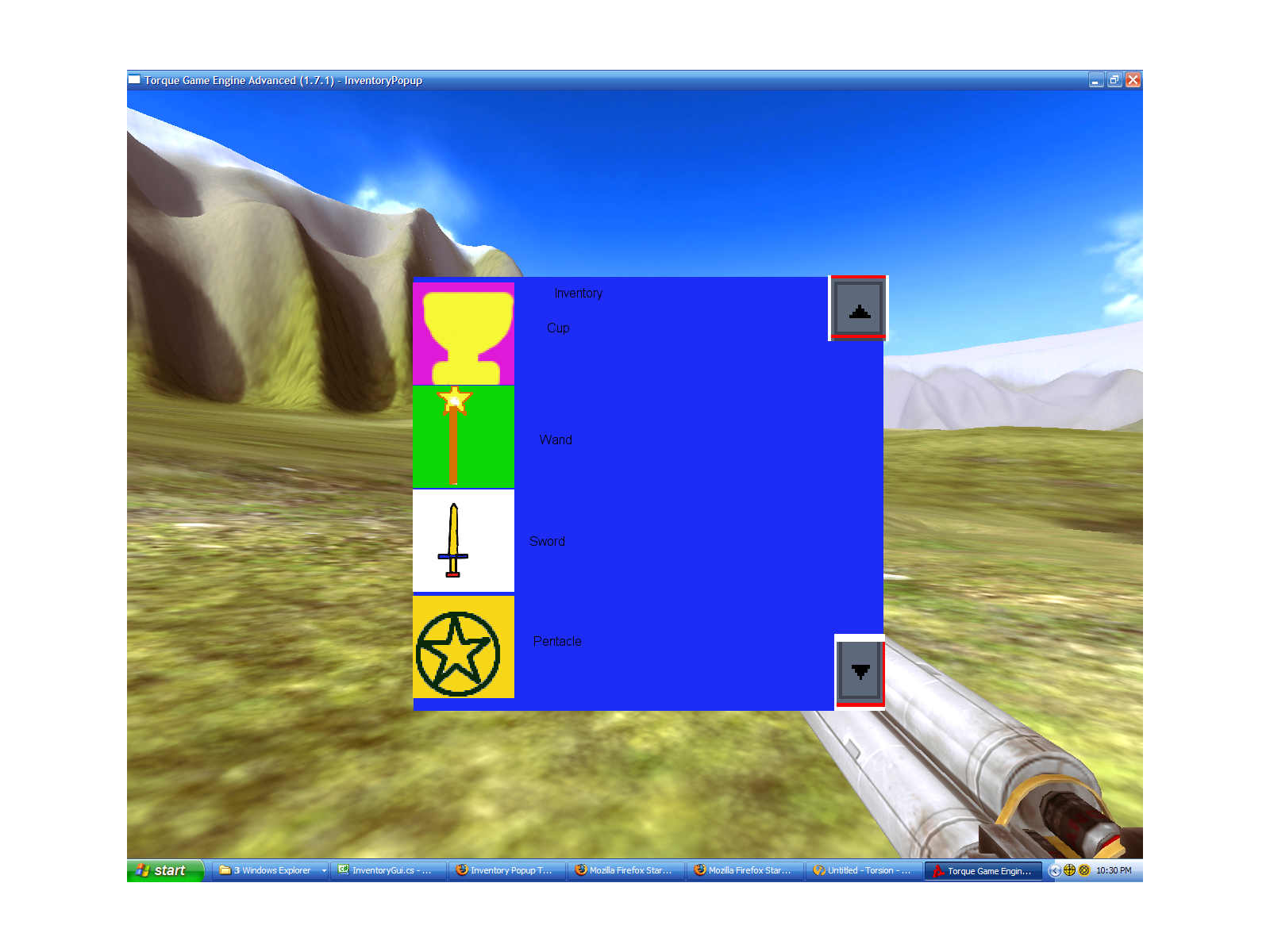
3) I also set up a working inventory system that tracks when a player picks up minor arcana items (wands, swords, pentacles, and cups), then registers these items in an inventory graphical user interface that can be toggled on and off.

Inventory GUI

Inventory GUI

4) I set up a simple spell system using resources provided on the GarageGames site, which allows the player to throw a fireball.

5) Wrote scripts for each of the cubes and items so that players can pick them up and store them in an inventory.  Made a small, rough test level using early versions of the battlements described in the “5 minutes of gameplay” entry to demonstrate that players can pick up cubes and items.  Here is one sample cube, followed by a video of the player picking up many of them, picking up several cups, and toggling the inventory.

6) The goal now is to first make the four minor arcana mountable as weapons so that they can be held by players, so that players can wield a sword or a cup in order to trace sigils in the air, like a hexagram.

Then, I need to set up a melee system that allows the player to swipe with the sword and do damage.

However, for the purposes of this game the motions of the items will have to be more precise, i.e. they will need to follow the movements of the gamepad as a sort of cursor.  Attached to the end of the sword, wand, or cup there will need to be a particle emitter or other special effect producer that leaves a glowing colored trail and recognizes when certain patterns have been traced.

Question: How did the designers of Arx Fatalis (or Molyneux in Black and White) pull of a similar “tracing magic sigil with finger” mechanic?

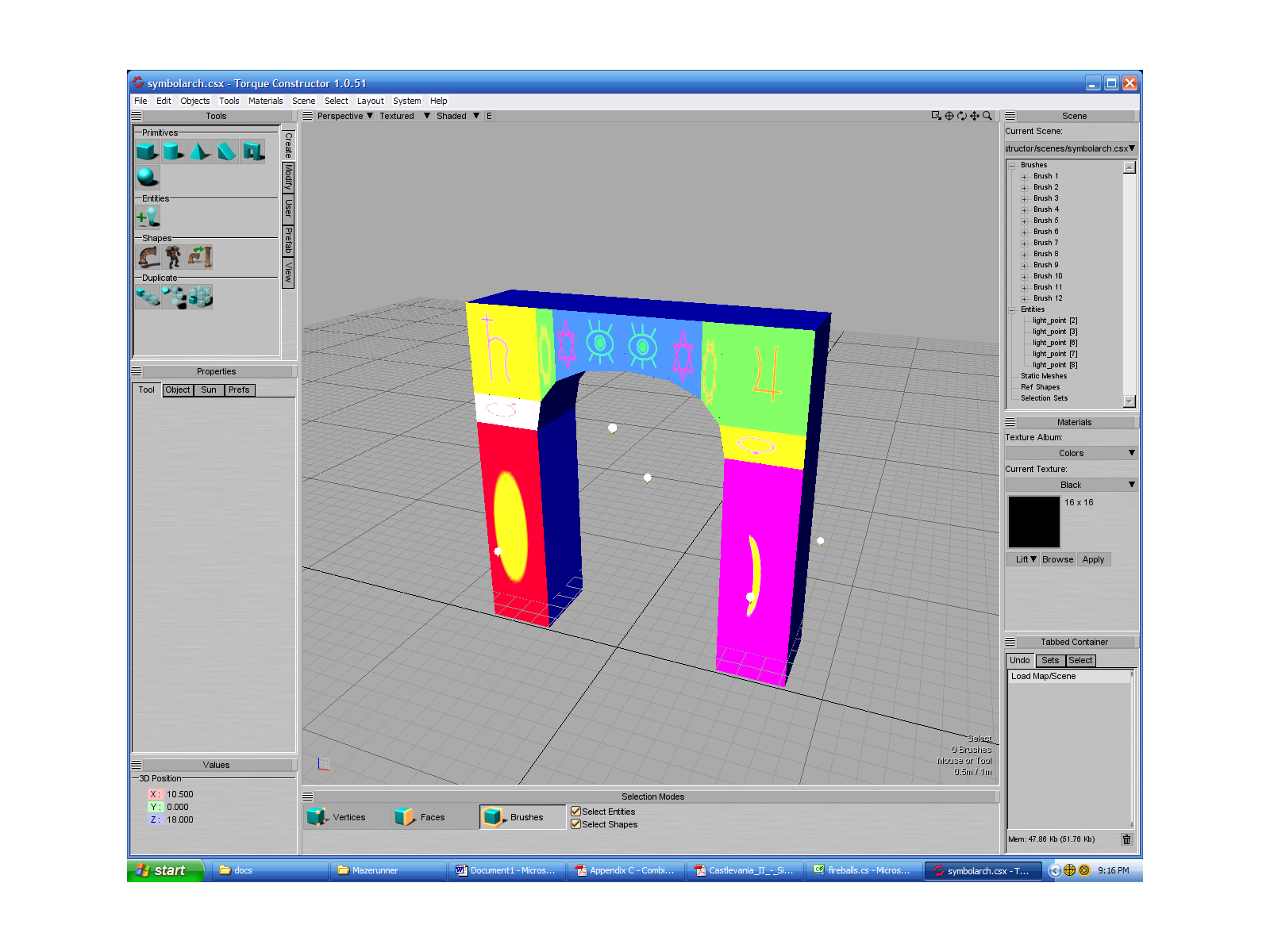
7) While I’m providing screenshots, here is an arch with some custom alchemical planetary symbols applied to it as textures.

Arch with planetary textures

Tags: , , ,