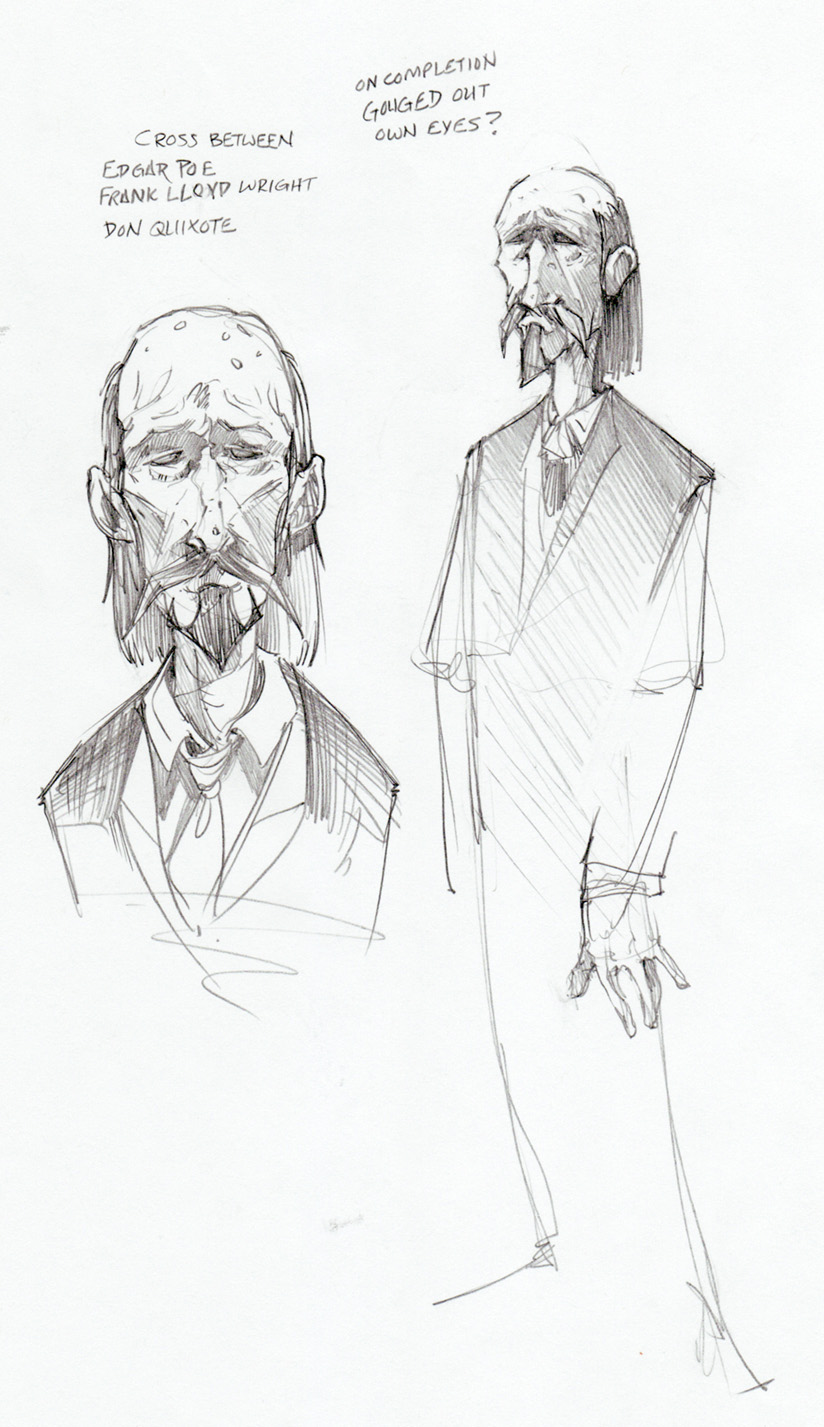
Trent Troop, a founder along with the aforementioned Ron Smith of the tabletop RPG and transmedia art company Octavirate, as made some excellent concept sketches of tarot-based NPC’s. I really appreciate the work that Trent and Ron are doing.
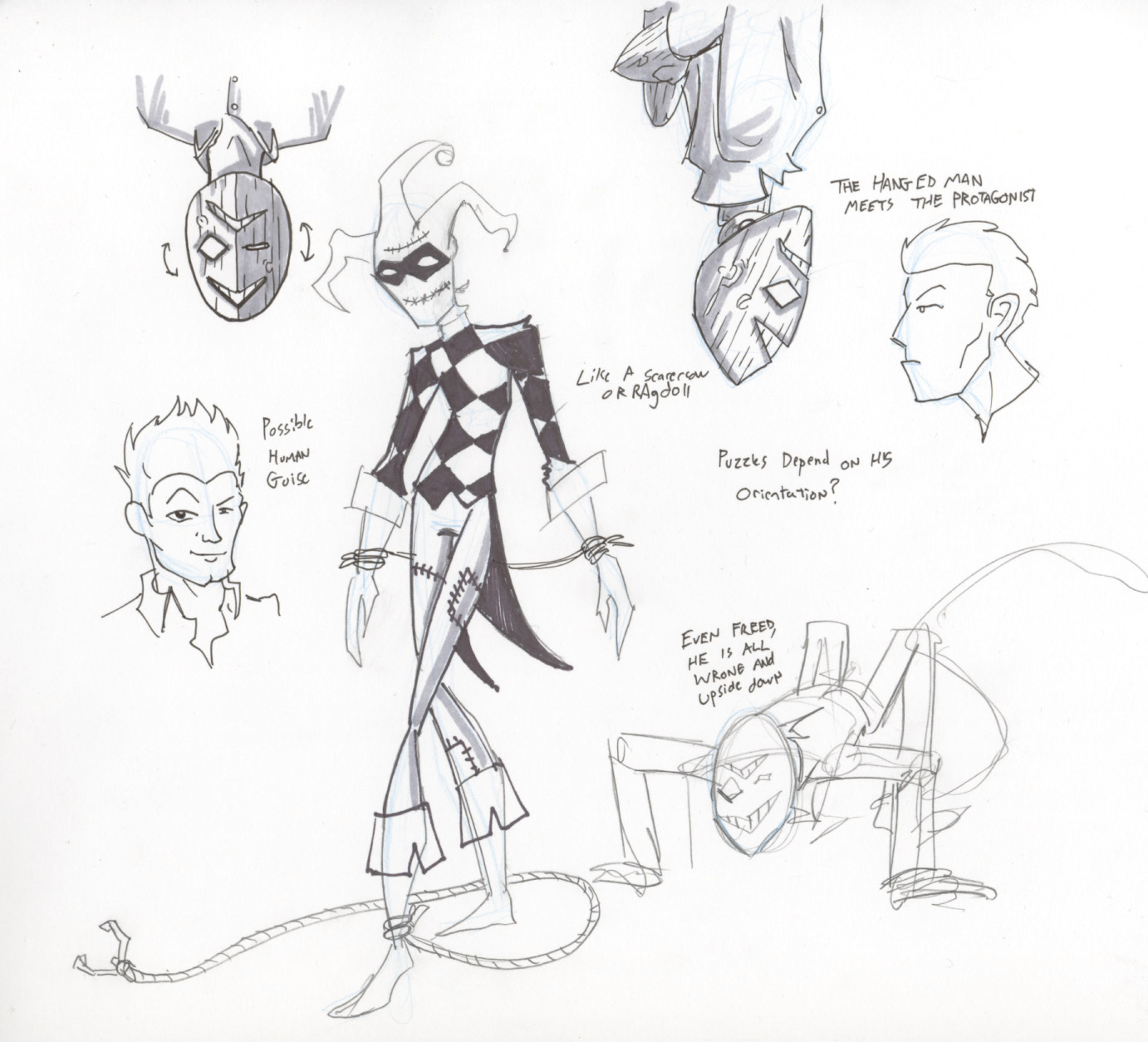
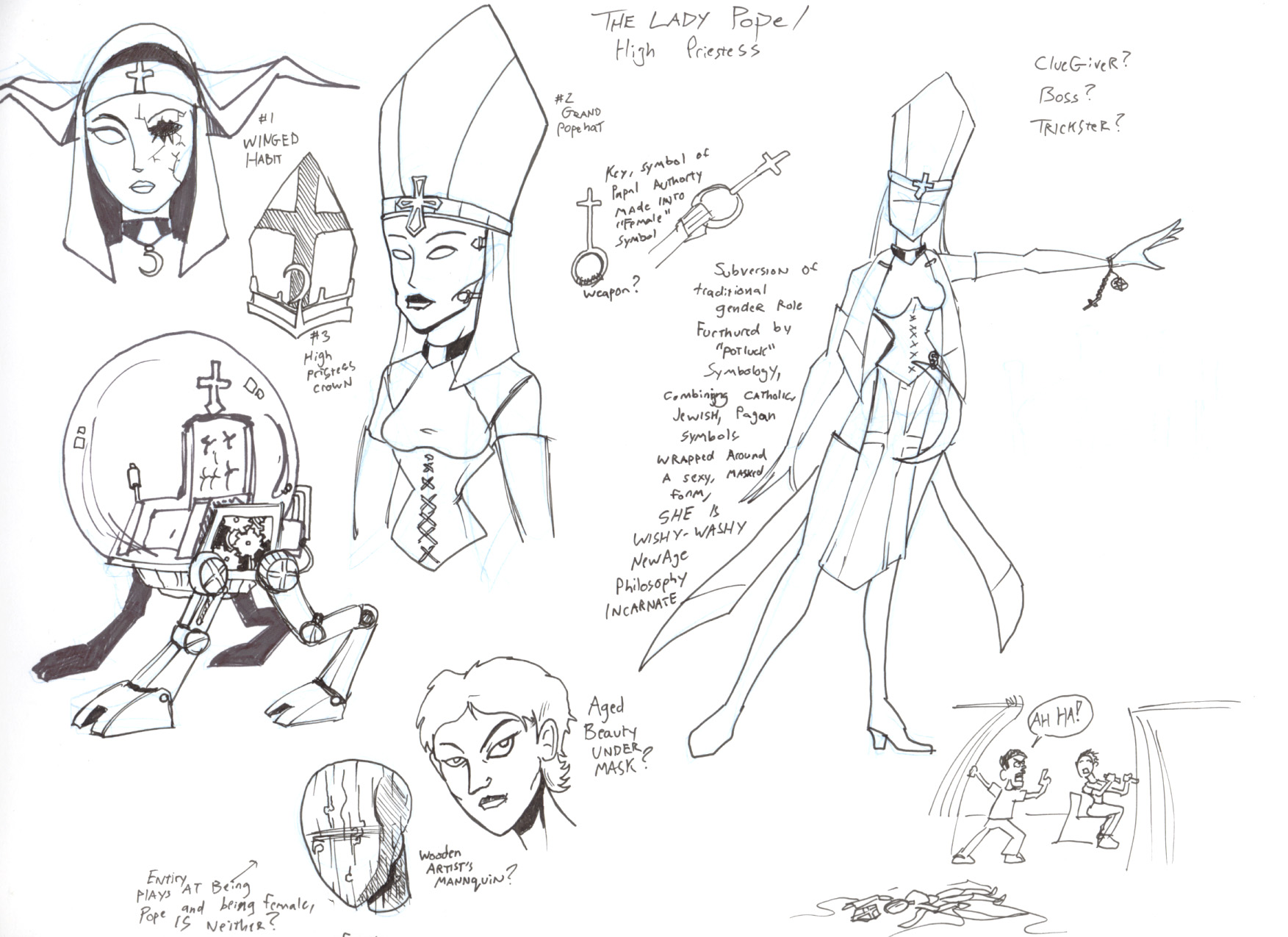
Trent Troop, a founder along with the aforementioned Ron Smith of the tabletop RPG and transmedia art company Octavirate, as made some excellent concept sketches of tarot-based NPC’s. I really appreciate the work that Trent and Ron are doing.
Here are seven more excellent concept sketches for Arcana Manor from Ron Smith, who is illustrating the surreal visual spaces of this particular quest game as well as defining the visual look of its central NPC (and indirect quest-giver), the architect Knossos.


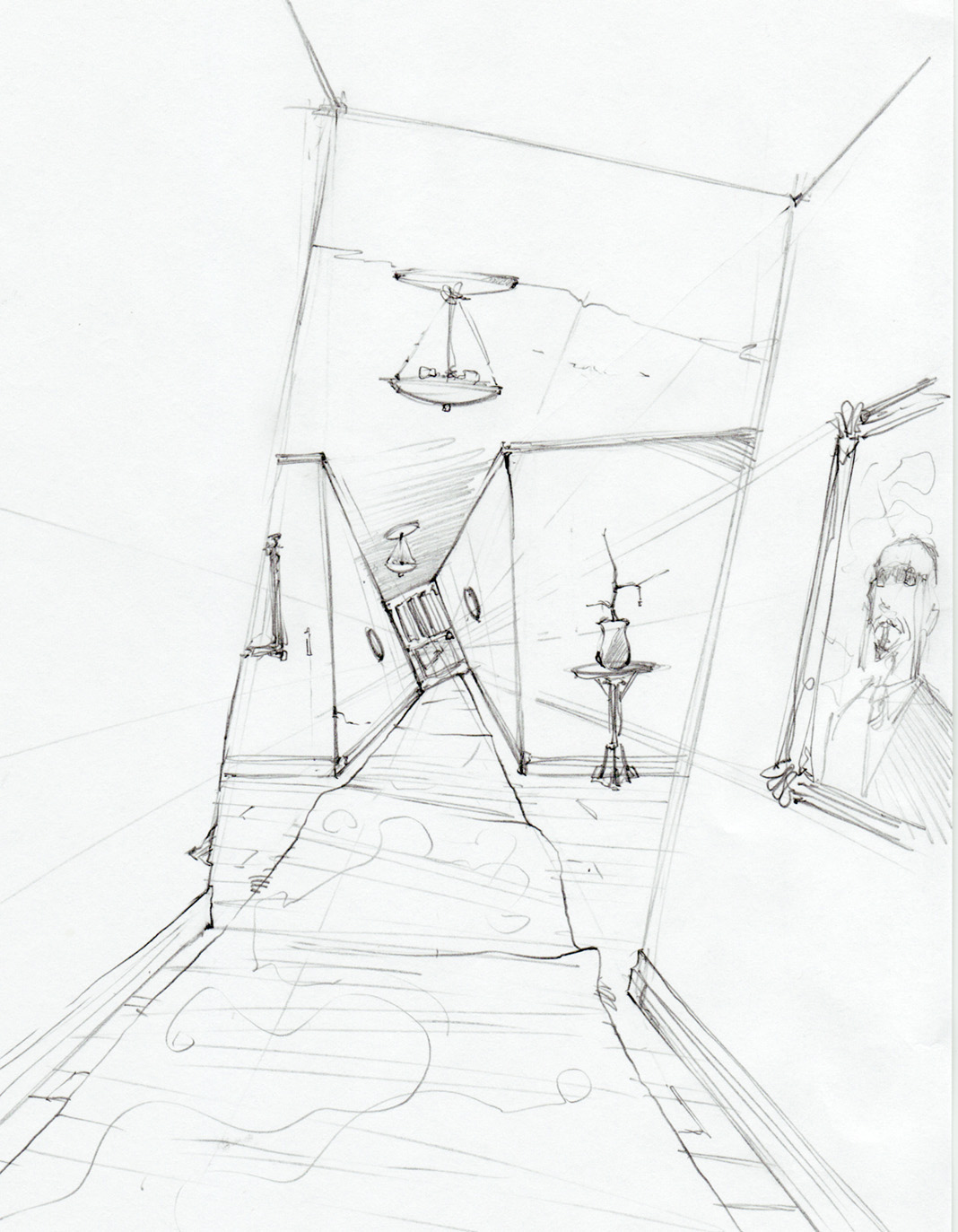

Here is a first concept sketch for Arcana Manor by my friend and collaborator Ron Smith. This sketch effectively conveys both the surreal, de Chirico-inspired spaces of the game as well as the creepiness of its starkly minimalistic inhabitants, who look like skeletal mannequins made of wax. Thanks to Ron for this.
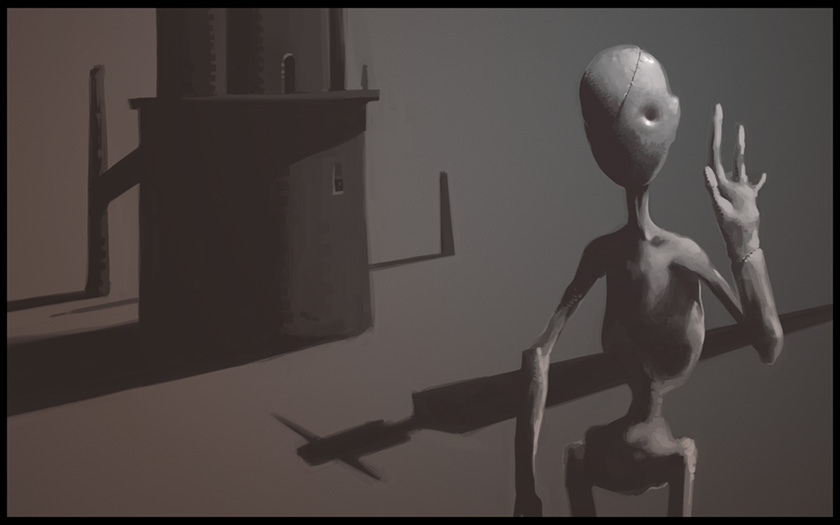
Concept Sketch # 1
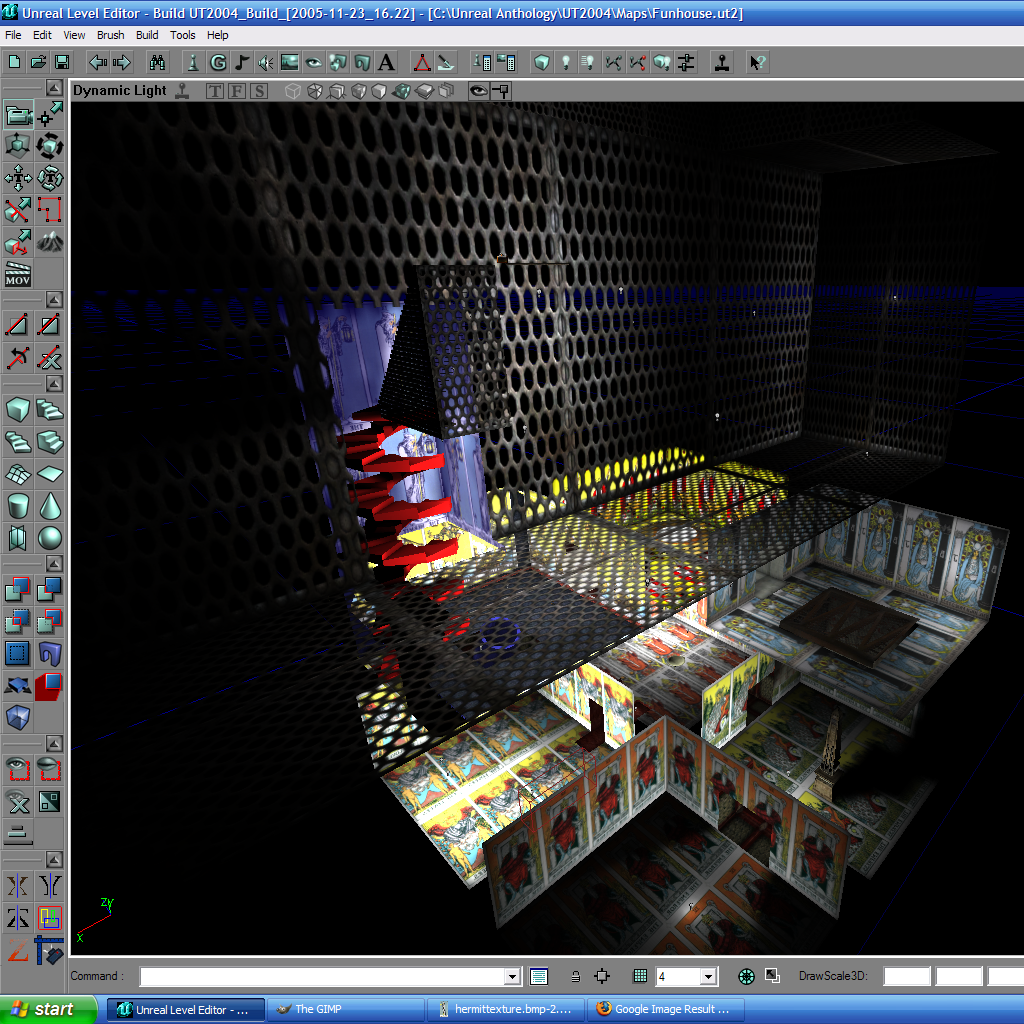
Below is a video of a small, rough prototype of one area Arcana Manor. I prototyped this section in the Unreal2 Editor a week or two ago and have since been working in Torque X. This video represents an extremely early stage of the process, intended only as a reference to illustrate the visual and spatial aesthetic for which I’m aiming.
The Arcana Manor team is beginning to shape up, thanks to friends and colleagues who have generously agreed to contribute concept sketches, models, and possibly music.
Kris Maxwell: audio and some 3d models
Trent Troop: some 3d models and concept sketches
Ron Smith: concept sketches
Thomas Falk: some music
I am moving ahead with Torque X 3d (which includes C#, Microsoft Visual Studio, and XNA), and I’ve just started working through tutorials in the Softimage XSI Mod Tool, a 3d modeling program that is bundled with Torque X 3d. I will be recruiting from the Torque and XNA communities to find other programmers familiar with this engine.
Here is a first screenshot from a very rough, small prototype I made in Unreal2 a while back.
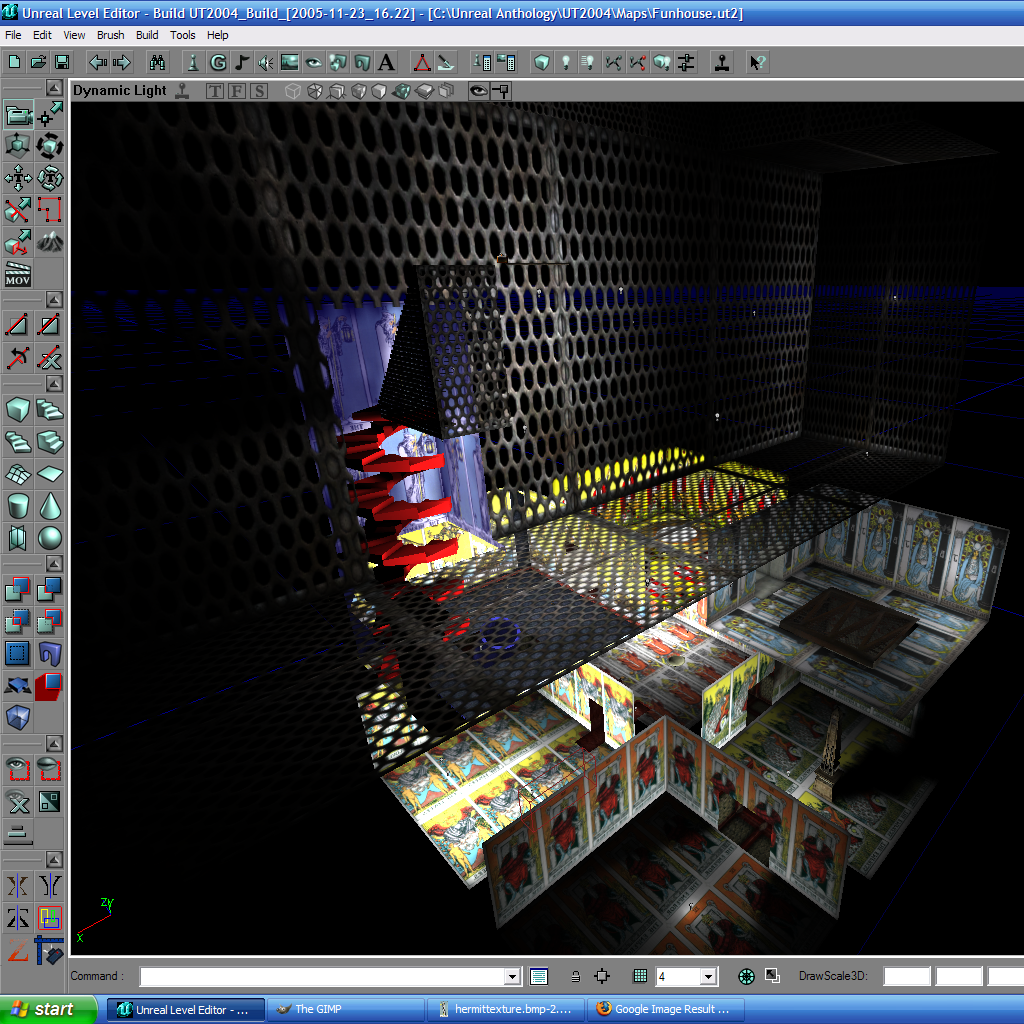
Prototype Screenshot # 1
Kris Maxwell came up with the following puzzle ideas for Arcana Manor. These ideas are good examples of innovative puzzle design, as advocated in the “challenges” chapter of Quests.
“theres’s a room with an empty picture frame suspended in the middle of the room. It is door-sized. Also in the room are several painted panels with sections of a stairwell painted on them. The player has to arrange the panels in 3D space, so that when they are looked at through the picture frame they complete the stairwell, which becomes real and the player can walk through the frame and into the stairs up to the exit.
alternatively it would be cool if you could put different things behind the frame to make different doors open. like panels that show a small room with a sword in a stone.. put them all in the right place so they look right through the frame, and then you can walk through the frame, into another dimension which contains the actual room with the sword, but that is not “physically” in the room with the frame (like a hypercube).”
“i also had an idea for a section of the funhouse that is not finished yet. This could progress from being unfinished in the gameworld (i.e. panels missing, surfaces half-painted, etc), through conceptual level (the section begins to be made of sketch lines, notes by the creator, and the look of scratch paper), and then onto a more meta-narrative level, where bits of the “engine” start to show through, featuring snippets of C# code and such, just to mess with people’s minds about the multiple layers of reality that are going on, and the peeling back of the layers of fiction that must be accomplished in order to solve the creator’s problem.”
“I think it would be spooky to have a scene in the game where the lights go out, you hear a sound, and then when you get the lights back on, things in the room have changed and there’s some ominous message left for you in the environment. (I just remembered the scene in Via Domus in the hatch cell with the lighter and the dead woman)
On that note, that’s something that Realms of the Haunting did well- using the environment to send messages, not just inventory items like notes (which it also uses). Hand-painted scrawls on walls and such just make things creepier. Maybe some of these could be linked to the blacklight stuff too.
Playing off the cancer theme, I think it would be good to work in references to that fear in some of the level designs or enemies… the idea of self-replicating growths, tumors, and the body turning on itself would make for a nice resonance with the underlying themes. It might also be thematically interesting to make the protagonist into the mythical Theseus, sent to slay the Minotaur, but the minotaur in this case is the creator transformed, and death by the hand of the protagonist is his salvation- he is set free having had someone complete his puzzle and play his game, and he can rest free from the pain of his rotting flesh and the demons of his infernal bargain. Just an idea.”
“some imagery/elements that might be fun/spooky/interesting:
a rickety elevator that descends extremely deep into the bowels of the manor
disembodies footprints that lead the character through a puzzle
statues that turn their heads to follow the hero as he moves through the room
a hallway where the camera does a “vertigo” effect (by moving forward and zooming out)
a hall of mirrors
a carousel with creepy/decaying animals as the seats (maybe one crepy one among all the pretty porcelain horses)
a fortune-teller
creepy cartoony eyes in the darkness
you have to have a room with black and white zig-zag tile floors and red curtains. period.”
Please click here to download a syllabus for a college-level class based on my book Quests.
I wrote Quests with many audiences in mind, and two key audiences are students and teachers within a college-level class about new media and literature, with an emphasis on game design and interactive writing. In fact, I wrote Quests to be sufficiently accessible and wide-ranging in its approach that teachers of many different classes could potentially use it as a textbook by adapting it to the needs of their students. Teachers of classes with titles like “Writing for Games,” “Writing for Interactive Media,” and “Introduction to New Media” could all use the book in different ways by putting varying degrees of emphasis on its theoretical and practical components, including its tutorials and exercises.
With these classes in mind, I have put together a syllabus for a class that would incorporate Quests as a textbook. The class has the same title as the book, but any of the course titles listed above would work equally well. In a syllabus divided into a the fourteen weeks of a standard college semester, I’ve assembled a set of discussion topics for each week, as well as accompanying assignments in reading, playing, and designing.
I’d love to hear back if anyone finds this syllabus useful in putting together his or her own course, and I’m very willing to discuss ideas for adapting this framework to the needs of particular teachers at the college, high school, or middle school level.
Design Document
Arcana Manor
3D, first-person action-adventure/platforming game about leaping, swinging, and crawling through a surreal funhouse while battling demons
Genre and core mechanic:
(The player finds the spellbook/architectural notebook that belonged to Knossos. This becomes the game’s journal/interface, from which spells are cast. A tarot-based pattern to the layout of the funhouse (22 rooms of the major arcana))
Level design and visual style:
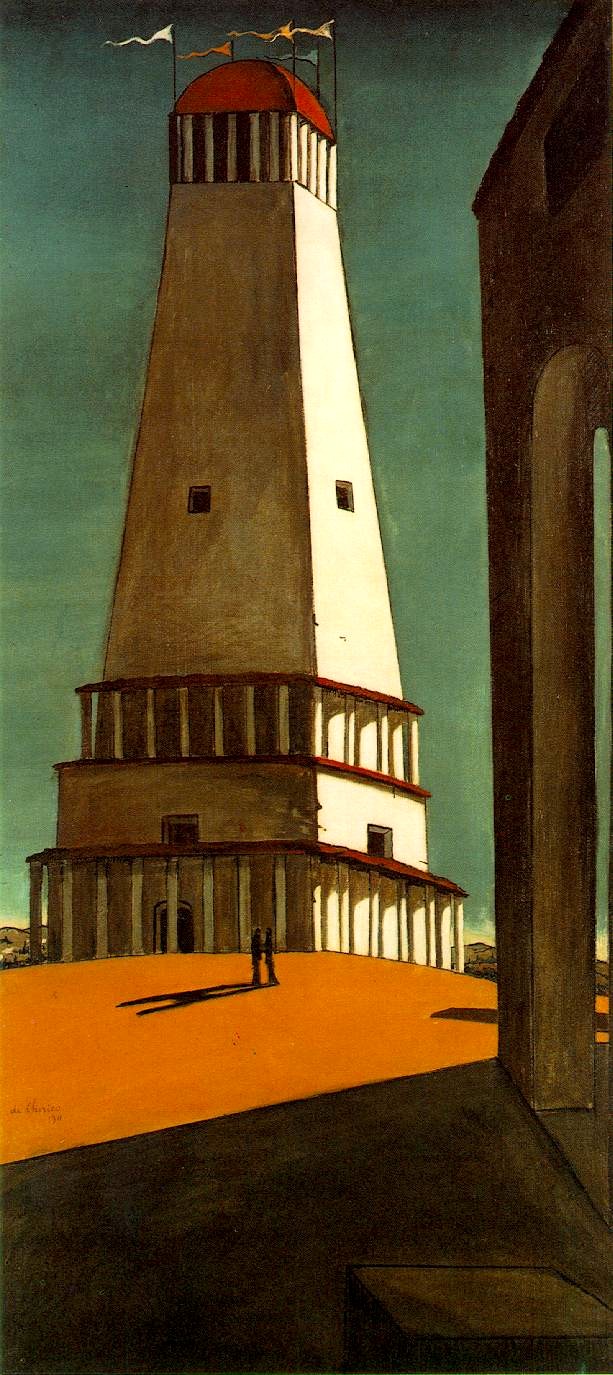
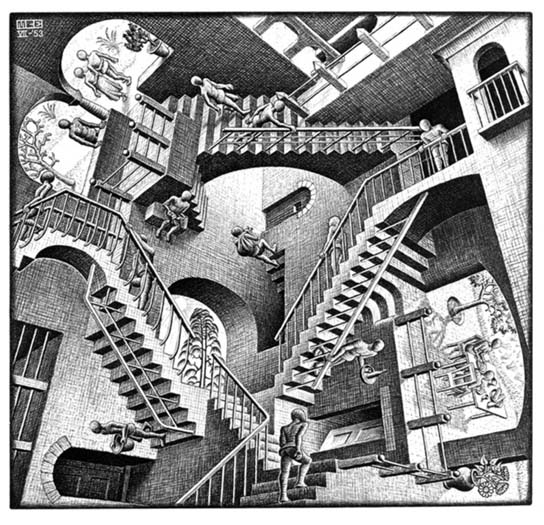 3. Christopher Manson’s Maze
Small sample map (a section of a part of a level)
Narrative
Dedalus Knossos, the Hierophant
Maximillian Knossos
Dedalus Minos
Dedalus de Chirico
M.C. Knossos
Technology
Prototype in Unreal 2 or Unreal 3 engine
Maya PLE or Blender for 3d models
Photoshop (GIMP temporarily) for concept art
Later, transfer to Torque or Torque X with a $150 dollar indie license (versus 350,000 dollar license per programmer of Unreal 3)
A combination of Torque X and Microsoft XNA would yield a game that could be played on both PC and Xbox Live Arcade
torquex 3d builder + torquex + microsoft xna 2.0 + visual c# + Microsoft XNA = 3D Xbox 360 game, distributable on Xbox Live Arcade
Comparable Titles
Undying (a FPS with spell-casting in a haunted mansion), but Arcana Manor is not a shooter and has more environmental puzzles.
Psychonauts (for surrealism and bizarre level design), but Arcana Manor is contained within a mansion and can be accommodated in a more standard, less resource-heavy engine.
Early graphical adventure games for stark, minimalistic surrealism (The Demon’s Forge, The Labyrinth of Time), but this has more exciting action than a point-and-click adventure game.
Team
Need concept artist(s)
3d modeler(s)
Programmer(s) (UnrealScript, C++, and/or C#)
Vocal talent
Budget
Almost none
Use freeware, middleware with indie or semi-commercial licenses
Distribution
Web for PC
Xbox Live Arcade